Product overview
What is food grade potassium tripolyphosphate?
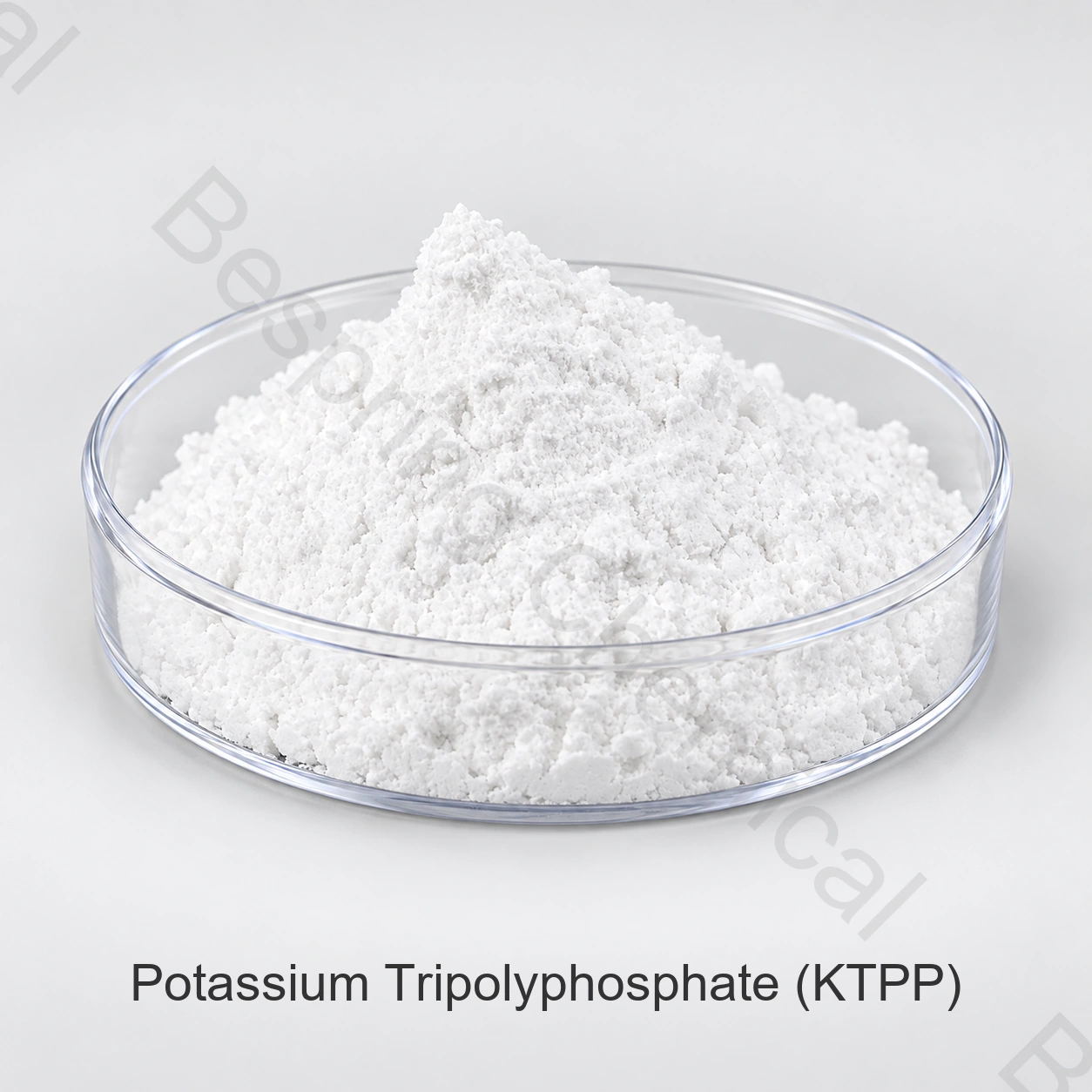
Food grade potassium tripolyphosphate (KTPP), also called pentapotassium triphosphate, is the potassium salt of triphosphoric acid: CAS 13845-36-8, formula K5P3O10, INS 451(ii). The FAO/WHO JECFA identity record identifies these names and number. The formula has no specified water of crystallization; formula weight is 448.42 g/mol in the published JECFA monograph. The commercial specification below covers food-grade white powder with KTPP content ≥90.0%. Liquid and industrial grades require separate specifications.
KTPP differs from sodium tripolyphosphate (STPP) in its cation, and from tetrapotassium pyrophosphate (TKPP) in its phosphate structure. Changing salts changes composition and can change formulation response. Compare the offered grade, dissolution and process trials instead of assuming an equal-mass substitution.
Functional roles
Why is KTPP evaluated in food formulations?
The published JECFA monograph lists a texturizer function and describes a hygroscopic, very water-soluble material. Emulsification, moisture retention and sequestration are additional formulation objectives. Their suitability depends on the selected grade, food system and processing conditions.
Function group 01Emulsification and water management
In suitable protein foods, evaluate water binding and emulsion or binding performance in the complete phosphate system. Define protein and fat levels, salt, addition sequence, mixing, temperature and final pH.
- Measure purge and cooked yield against a control
- Assess emulsion stability and finished texture
- Verify dissolution in the actual water or brine
Function group 02Sequestration and mineral balance
Evaluate metal-ion interactions and pH alongside the selected food system. Water hardness, mineral load, other salts and heating can affect solution behavior and the trial outcome.
- Check clarity, sediment and dissolution time
- Record final-food pH, not only ingredient-solution pH
- Compare potassium and sodium contribution across the recipe
Food application screening
How should food manufacturers evaluate KTPP?
Select an application permitted in the destination market, then evaluate the powder under the intended formulation and processing conditions.
Protein systems
For permitted meat or poultry systems, define species, salt, brine temperature and injection or tumbling. Compare purge, cooked yield, texture and sensory quality with a control. Review meat and poultry phosphate selection.
Dairy and cheese
In suitable processed-cheese or dairy systems, evaluate KTPP as part of the full emulsifying-salt system. Define protein/mineral balance, final pH, heat and shear; assess oil separation, melt, viscosity and flavor. Review dairy phosphate formulation.
Seafood processing
For permitted seafood treatments, record species, raw/cooked/frozen state, treatment time and water chemistry. Measure drained uptake, thaw drip, cook loss, appearance and texture. Plan seafood phosphate trials.
Phosphate blends
Compare KTPP alone and in a declared food phosphate blend for dissolution, pH and application response. Include all phosphate sources in any required group-limit calculation.
Potassium and sodium balance
The named salt contains potassium rather than sodium. A recipe change requires composition review, sensory trials and appropriate finished-food analysis before making a sodium or nutrition claim.
Pilot validation
Approve a control, acceptance criteria and sampling plan before scale-up. Record mixing, dissolution and temperature/time conditions. Validate quality during processing and storage; no universal dose or shelf-life benefit is stated.
Product specifications
Food grade KTPP reference specification
The following commercial reference limits are separate from batch COA results. For an order, agree the required standard, analytical methods and reporting bases in the product specification; use the lot-specific COA for batch acceptance. Important differences from the cited JECFA specification are explained below.
On small screens, scroll horizontally. Keyboard users can focus the table region and use the arrow keys.
Potassium tripolyphosphate (KTPP) — supplied reference limits| Test item | Unit | Commercial reference | Analytical basis / purchasing requirements |
|---|
| K5P3O10 content | % | ≥90.0 | Confirm assay method and as-supplied or dried basis; this is not a total phosphorus result. |
|---|
| P2O5 content | % | ≤46.0 | P₂O₅-equivalent reporting; confirm analytical method and sample basis. See the comparison below. |
|---|
| Water-insoluble matter | % | ≤2.0 | Confirm filtration, washing and drying method. |
|---|
| Arsenic (As) | % | ≤0.0003 | Equivalent mass-fraction limit: ≤3 mg/kg. Request element-specific results and method. |
|---|
| Heavy metals (as Pb) | % | ≤0.001 | Equivalent aggregate limit: ≤10 mg/kg as Pb; not a separate lead result. |
|---|
| Fluoride (F) | % | ≤0.003 | Equivalent mass-fraction limit: ≤30 mg/kg. See the comparison below. |
|---|
| Cadmium (Cd) | % | ≤0.0001 | Equivalent mass-fraction limit: ≤1 mg/kg; confirm reporting limit. |
|---|
| Mercury (Hg) | % | ≤0.0001 | Equivalent mass-fraction limit: ≤1 mg/kg; confirm reporting limit. |
|---|
| pH value | — | 9.5–10.5 | Specify solution concentration, test temperature and water quality when comparing pH results. |
|---|
| Loss on drying at 105°C | % | ≤0.7 | Specify drying duration at 105°C. Loss on drying is distinct from loss on ignition. |
|---|
| Appearance | — | White powder | Request particle-size distribution and bulk density where relevant to mixing or handling. |
|---|
Reporting basis: Percentage-to-mg/kg expressions above are unit conversions of the listed limits, not measurements. KTPP assay, P₂O₅-equivalent content and elemental phosphorus are different reporting quantities; do not replace one with a theoretical conversion or another test.
Purchasing against a JECFA specification
The JECFA Monograph 1 specification (2006 compilation; metals revision 2004) lists KTPP assay ≥85% on the dried basis, P₂O₅ 46.5–48.0% using a dried sample, fluoride ≤10 mg/kg and lead ≤4 mg/kg. The commercial limits above list P₂O₅ ≤46.0% and fluoride ≤30 mg/kg, and provide a heavy-metals aggregate instead of an individual lead limit. The assay basis must be specified. These differences mean the commercial table alone does not establish conformity with that monograph.
The same reference uses loss on ignition ≤0.4% after drying at 105°C for 4 hours and ignition at 550°C for 30 minutes; the commercial ≤0.7% loss on drying is a different test. Its pH range is 9.2–10.1 for a 1-in-100 solution; compare only with defined solution conditions. Purchases against a JECFA specification require the agreed edition, corresponding methods and element-specific batch results. The FAO record and specification links provides access to other editions; specify the edition required for your purchase.
Technical documentation
Product documents and market requirements
Product documents
Request a grade-specific specification/TDS, SDS and representative COA. Specify any additional analytical methods, particle-size data and batch results required for acceptance. Available documents depend on the grade and supply source.
Quality documents
Include any HACCP, Kosher, Halal or ISO document requirements in your inquiry. The document scope and validity must cover the relevant product and production site.
Food-market requirements
The Codex GSFA phosphate group includes INS 451(ii). Group provisions and notes depend on the food category; Note 33 expresses relevant limits as phosphorus. Use must meet destination-market rules for the specific food category, total phosphate calculation and labeling.
Storage and handling
Protect KTPP from heat and moisture
- TemperatureStore at no more than 30°C, in accordance with the supplied product instructions.
- EnvironmentKeep bags sealed in a cool, dry, ventilated place away from sunlight, heat, humidity and contamination.
- Workplace controlsFollow the current SDS and site procedures for dust control, hygiene and personal protection. Shelf life and expiry should be specified in the supplied product documents.
Buyer questions
Food grade KTPP FAQ
Is KTPP the same as TKPP or STPP?
No. KTPP is potassium tripolyphosphate (CAS 13845-36-8). TKPP is a potassium diphosphate, while STPP is a sodium triphosphate. Their composition and formulation response differ, so substitution requires a validated recipe.
What does the ≥90.0% reference assay mean?
It is a commercial limit for KTPP content, not a batch test result. The specification should state the analytical method and whether the result is on an as-supplied or dried basis. P₂O₅-equivalent content is a separate analytical item.
Can I order against a JECFA specification?
State the required edition and analytical requirements in your inquiry. The commercial P₂O₅ and fluoride limits above differ from the cited JECFA specification, and additional method and individual lead information is needed. Compliance requires an agreed specification and supporting batch results.
How should I evaluate KTPP in a food process?
Use an application permitted in the destination market. Compare a control with candidate formulations under the intended water or brine composition, pH, addition sequence, mixing, temperature and time. Measure dissolution and the relevant texture, purge, emulsion or stability outcomes.
What packing, MOQ and container loading are listed?
The commercial reference figures are a 25 kg bag, a 500 kg minimum order and 22 metric tons per 20-foot container. The quotation defines the liner, pallet arrangement, final net load and delivery terms.
What should I include in a quotation request?
Send the food application, product standard and edition, assay basis, key impurity limits, quantity, packaging, destination port, Incoterm and delivery requirements. List the specification, COA, SDS and any additional documents needed.
Related potassium phosphates
Compare adjacent food-grade options
Compare a metaphosphate with a different structure and grade-specific specification; it is not an automatic replacement for KTPP.
Compare an orthophosphate for a different pH and formulation role; review the specific application and food standard.
Compare a diphosphate for selected emulsification, sequestration and texture systems; qualify its own specification and recipe response.
Also compare food grade STPP for the sodium triphosphate option or declared food phosphate blends for combined functions. Neither option implies an equal-dose substitution.