Identity and purity
Qualify INS 621 identity, sodium glutamate content, rotation, loss on drying, clarity and elemental limits.

Food grade ingredient · Umami flavour enhancer · INS 621
Food grade monosodium L-glutamate (MSG), INS 621, is the sodium salt of L-glutamic acid used as an umami flavour enhancer in suitable savoury foods and seasoning systems.
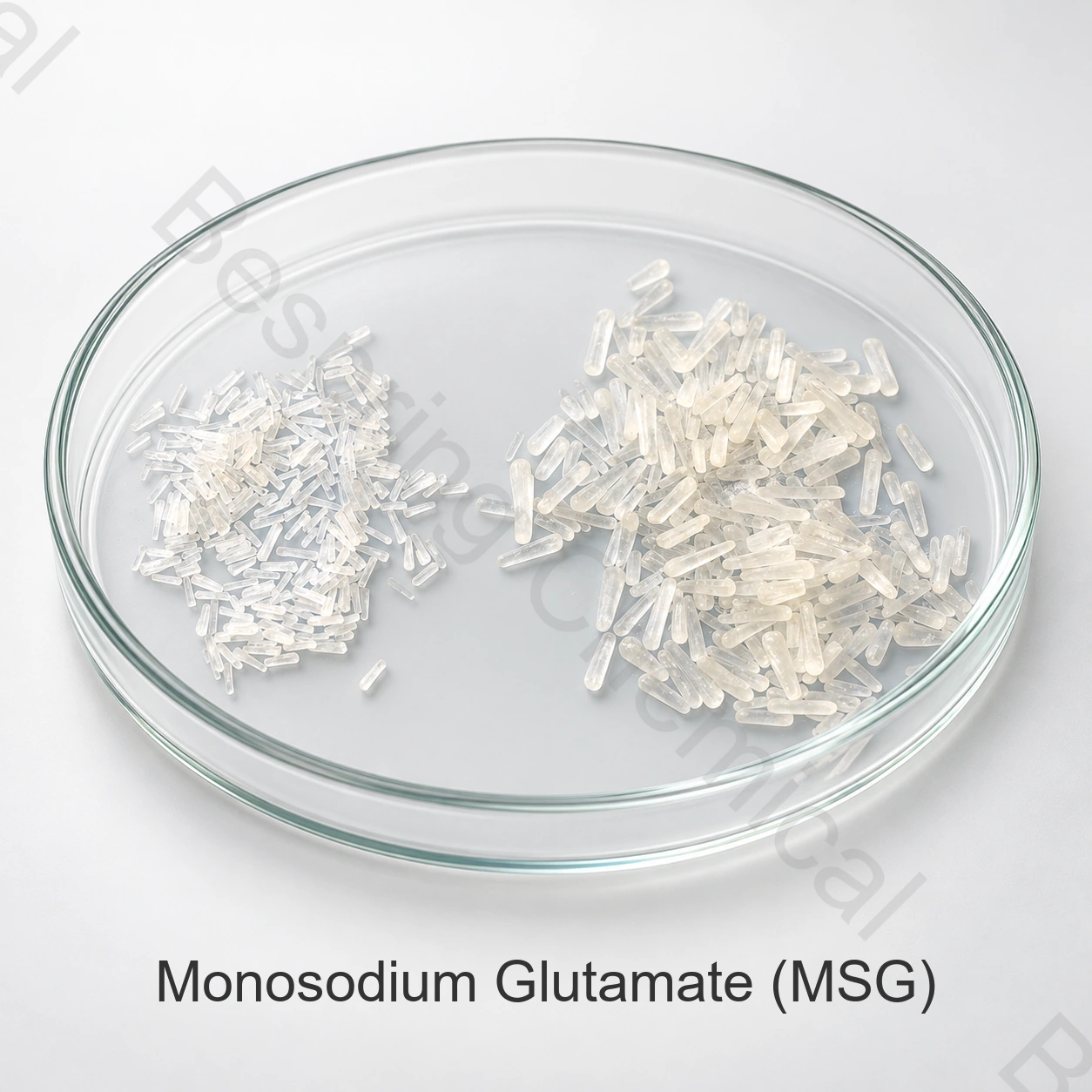
Product image · confirm grade and packaging when ordering
Share the application, critical limits, test methods, quantity, packing and destination.
GradeFood grade, subject to source qualification
PackingConfirm bag type, net weight and particle-size option
Container loadingConfirm against selected packing and destination
Batch evidenceCurrent specification and COA required
Direct product answer
Food grade monosodium L-glutamate (MSG), INS 621, is the sodium salt of L-glutamic acid used as an umami flavour enhancer in suitable savoury foods and seasoning systems.
For procurement, “food grade” must be supported by a current source-specific specification, suitable manufacturing and quality documents, and a batch COA. Final use depends on the complete formulation, intended function and destination-market rules.
Procurement checklist
Use these qualification points when comparing a China supplier, manufacturer source, distributor offer, bulk quotation or sample.
Qualify INS 621 identity, sodium glutamate content, rotation, loss on drying, clarity and elemental limits.
Provide seasoning composition, salt level, target flavor profile, particle-size need and mixing process.
State crystal grade or mesh, quantity, packing, destination, certificates and delivery terms.
Evaluate dissolution, particle match, sodium contribution and sensory performance in the complete seasoning.
Application screening
These are application-screening areas, not universal approvals or dosage recommendations. Confirm legal use and performance in the finished food.
Adds umami impact and can help round out savoury flavor profiles in dry blends.
Used in suitable recipes after sensory trials, sodium calculation and label review.
May be incorporated into seasoning powders where particle size and blend uniformity are controlled.
Can be evaluated in meat, seafood or vegetable-style formulations subject to market rules.
Supplied technical data
The following values reproduce the technical information supplied in attachment 9. Particle size is not defined in the source and must be agreed before ordering.
Swipe or use the keyboard to read all columns
| Test item | Supplied reference |
|---|---|
| Sodium glutamate | ≥ 99% |
| Particle size | Not specified in source |
| Transmittance | ≥ 98% |
| Specific rotation [alpha]D20 | +24.90 to +25.30 |
| Loss on drying | ≤ 1% |
| pH | 6.7–7.5 |
| Iron | ≤ 5 ppm |
| Sulfate | ≤ 0.05% |
| Arsenic | ≤ 0.5 ppm |
| Lead | ≤ 1 ppm |
| Zinc | ≤ 5 mg/kg |
Data note: The attachment shows particle size only as “***”. Specify mesh, crystal size distribution or visual grade as a contractual requirement if it matters to dosing, dissolution or appearance.
Technical selection
Define fine, regular or coarse crystal requirements using an agreed sieve method.
Run sensory trials in the finished recipe; MSG is not a substitute for balanced formulation.
Include MSG sodium contribution when reviewing nutrition and formulation targets.
Check specific rotation, transmittance and impurity results on the current COA.
Qualification support
Request the current signed specification or TDS, SDS, test methods, representative COA and batch COA.
Verify applicable food-safety, quality, Kosher, Halal and site documents for the exact grade and source.
Review the FAO/JECFA monosodium L-glutamate record, then apply destination-market rules to the exact finished food.
Storage and handling
Buyer questions
INS 621 is monosodium L-glutamate, commonly called MSG. It is used as an umami flavor enhancer in permitted savory food applications; E621 is the corresponding European designation.
No. MSG is a sodium salt of glutamic acid, while table salt is sodium chloride. Their taste and composition differ, so salt-reduction work requires sensory testing and a calculation for the complete recipe.
Select crystal size against dry-blend particle matching, dosing, dissolution and appearance requirements. The reference specification on this page does not define particle size; agree it explicitly with the source.
Request the current signed specification, analytical methods and representative and batch COAs. Confirm identity, assay, specific rotation, clarity and the relevant impurity limits for the selected grade.
Provide the seasoning or food application, crystal-size requirement, target standard and critical limits, quantity, packing, destination, certificates and delivery terms.
Content updated 2026-09-13.
Related ingredients
Review another preservative option and its procurement specification.
Review another food phosphate and its sourcing considerations.
Browse the full ingredient portfolio and available technical dossiers.
Related application guidance: Prepared foods, sauces and fillings.
Specification-led sourcing
Share the application, target grade and limits, quantity, packing, destination and required documents for a relevant bulk-supply proposal.
Tell us your grade and destination market so we can confirm which documents are available for your order.
An external reference is not a batch certificate or a Bespring product specification.