Equilibrium pH
Measure the finished product after processing and equilibration. Acid type, buffering capacity and particulates can make an ingredient-stage reading misleading.

Food preservative · Acidic systems · E211
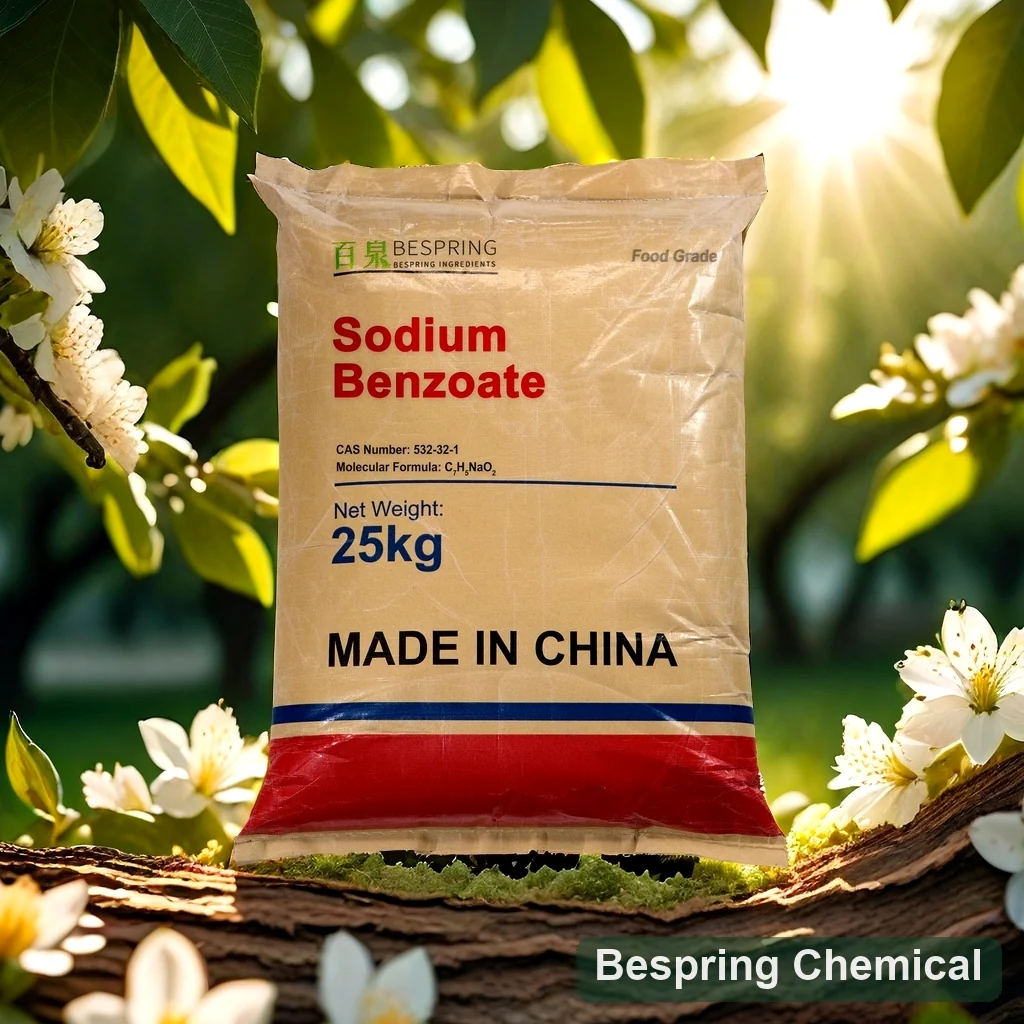
Product image · confirm grade and packaging when ordering
Share particle form, specification, finished-food pH, formula risks, quantity, packing and destination.
Particle choicesPowder · spherical · cylindrical granules
Reference packing25 kg woven bag
Reference MOQ500 kg
Batch qualificationSpecification and COA on request
Product identity
Sodium benzoate is the sodium salt of benzoic acid. JECFA identifies it as INS 211, CAS 532-32-1, formula C7H5NaO2 and formula weight 144.11. It is freely soluble in water and supplied commercially as crystalline powder, flakes or granules.
After dissolution, benzoate participates in the benzoic-acid equilibrium. This is why finished-product acidity is central to performance and why ingredient dosage alone cannot predict microbial stability or shelf life.
Preservative system design
Sodium benzoate belongs inside a hurdle strategy, not outside it. Define the formulation and process variables before selecting a supplier sample or interpreting a shelf-life result.
Measure the finished product after processing and equilibration. Acid type, buffering capacity and particulates can make an ingredient-stage reading misleading.
Identify spoilage yeasts, moulds and relevant bacteria plus the starting load. Do not describe benzoate as universal pathogen control.
Review heat treatment, hold time, cooling, filling and post-process contamination. Preservative use does not validate an inadequate thermal process.
Challenge the final package under realistic oxygen, light, temperature, transport and after-opening conditions across repeat batches.
A COA can demonstrate the tested sodium benzoate lot against an agreed specification. It cannot demonstrate that a beverage, sauce or filling meets microbiological, sensory or shelf-life acceptance criteria.
Application pathways
These are formulation pathways, not universal approvals or use levels. Confirm the exact food category, maximum level and declaration requirements for the destination market.
Evaluate: pH, titratable acidity, benzoate/ascorbate system, flavour, process, light, temperature and package life.
Evaluate: acid distribution, oil/water phases, particulates, hot-fill or cold-fill process, package and after-opening use.
Evaluate: equilibrium pH, brine strength, solid-to-liquid distribution, heat process, seal integrity and storage.
Evaluate: soluble solids, water activity, pH, target spoilage, sensory quality and contamination after processing.
Beverage formulation checkpoint
The U.S. FDA reports that benzene can form at very low levels in some beverages containing both benzoate salts and ascorbic acid (vitamin C) or erythorbic acid. Heat and light can stimulate formation in some formulations.
This is a finished-beverage formulation and storage issue, not evidence that every benzoate-containing drink forms benzene. Review the full recipe, raw-water and metal-ion controls, processing, package, light exposure, temperature and suitable analytical verification.
Source-specific technical data
The table reproduces the supplied attachment for procurement screening. Ambiguous labels remain flagged rather than silently rewritten. The signed specification, methods and shipment COA govern acceptance.
Swipe or use the keyboard to read all columns
| Test item | Reference value | Purchasing requirements |
|---|---|---|
| Appearance | White powder or granules | Confirm powder, spherical or cylindrical form |
| Content, dry basis | ≥ 99.0% | Matches JECFA minimum; confirm method |
| Acidity | ≤ 0.2 mL | Titrant, normality and sample basis not stated |
| Moisture | ≤ 1.5% | Confirm whether equivalent to LOD and its method |
| Aqueous solution test | Clear | Confirm concentration and visual method |
| Heavy metals, as Pb | ≤ 10 mg/kg | Not a separate lead result |
| Arsenic | ≤ 2 mg/kg | Reference value |
| Chloride | ≤ 0.02% | Definition differs from “total chloride” below |
| Sulfate | ≤ 0.1% | Reference value |
| “Oxides” | Meets requirements | Specify the test identity and method |
| Solution colour | Y6 | Request comparator/method |
| “Phthalates” | Meets requirements | Specify the analytes and test method |
| Total chloride | ≤ 0.03% | Resolve against chloride ≤0.02% |
| Alternative limits | As agreed with customer | Must be fixed in the contractual specification |
Confirm assay basis, loss-on-drying method, lead, acidity/alkalinity and relevant impurity tests for the required grade. Use the agreed specification and test methods for acceptance; a public standard does not replace the delivered batch’s COA.
Review the FAO/WHO JECFA sodium benzoate monograph, Codex GSFA benzoates group and the FDA beverage benzene Q&A. These public sources do not prove a Bespring lot or universal market permission.
Technical content reviewed against the cited public references on 22 August 2026. Commercial specifications and destination-market requirements must be reconfirmed.
Physical form & logistics
Particle form affects dust, flow, dosing, dissolution and container loading; it does not change the sodium benzoate chemical identity. Confirm the offered form and loading basis in the quotation.
Assess dust control, feeder behaviour, dissolution procedure and the stated 16 MT non-palletised or 12.5–13 MT palletised reference loading per 20GP.
Assess flow, attrition and dissolution; supplied reference loading is 20 MT without pallets or 16 MT with pallets per 20GP.
Assess feeder fit, breakage and dissolution; supplied reference loading is 15.5–16 MT without pallets or 12–13 MT with pallets per 20GP.
Request the current specification/TDS, SDS, representative COA, shipment COA and only those certificates that apply to the exact product and supplying site. Reconfirm liner, pallet, marks, moisture protection and Incoterm.
Preservative selection
Compare target organisms, pH response, sorbic-acid equilibrium, sensory profile and finished-product evidence.
Compare acid form, lower water solubility, addition method, pH and active-acid basis.
Compare acetate/acetic-acid functionality, flavour contribution, application fit and sodium strategy.
Compare bakery mould/rope targets, dough compatibility and preservation-system conditions.
Storage & handling
Buyer questions
After dissolution it participates in the benzoic-acid equilibrium. Finished-product pH and buffering affect the proportion of undissociated benzoic acid, so performance must be tested in the actual formulation.
FDA reports that very low benzene levels can form in some beverages containing benzoate salts with ascorbic or erythorbic acid, and that heat and light can stimulate formation in some formulations. Review and test the complete beverage rather than assuming every formulation behaves the same way.
No. It may contribute to a validated hurdle system, but it does not validate an inadequate heat process, poor hygiene, unsuitable packaging or uncontrolled storage.
They have the same chemical identity but may differ in dust, flow, feeder behaviour, dissolution and container loading. Qualify the physical form in the actual handling system.
The supplied information states 25 kg woven bags and a 500 kg reference MOQ. Container loading varies substantially by particle form and palletisation.
Provide the standard, particle form, food category, final pH, full preservative/antioxidant system, critical limits, quantity, packing, destination, certificates and target date.
Last technically reviewed on 22 August 2026 by the Bespring Chemical technical and export team.
Continue your evaluation
Product, packing and handling references
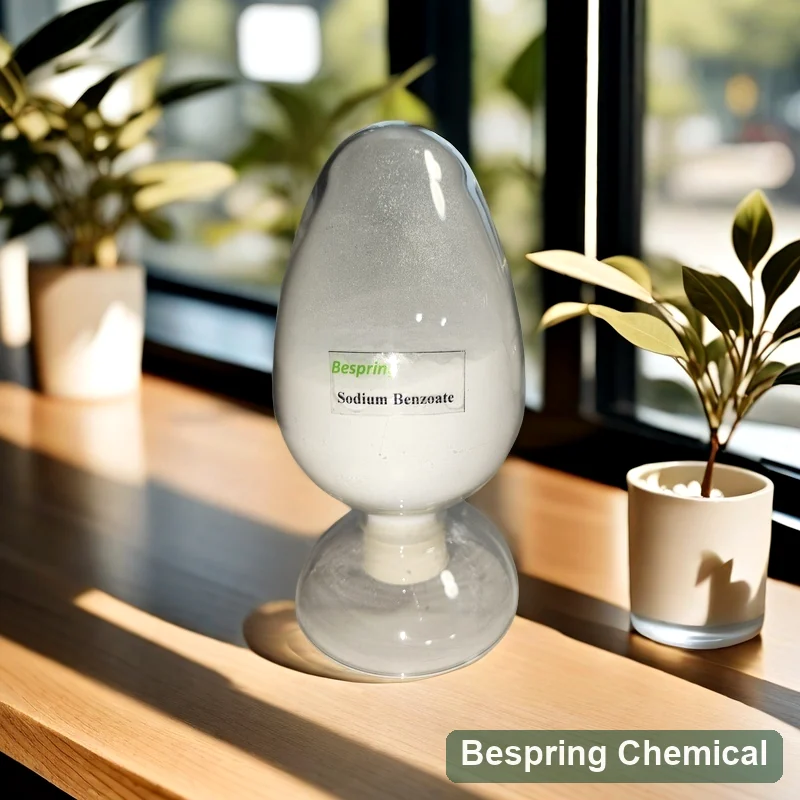
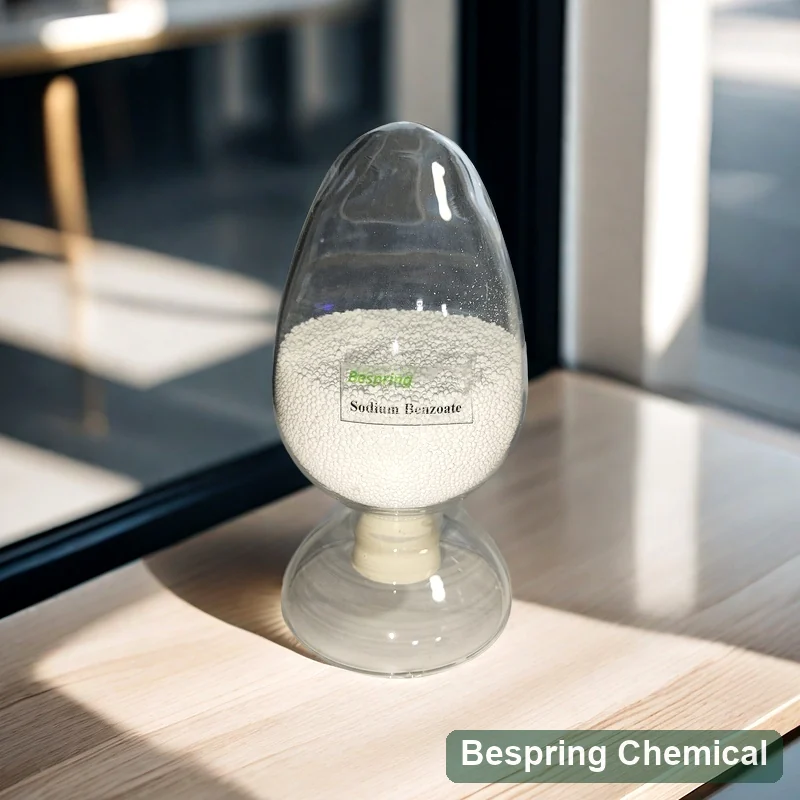
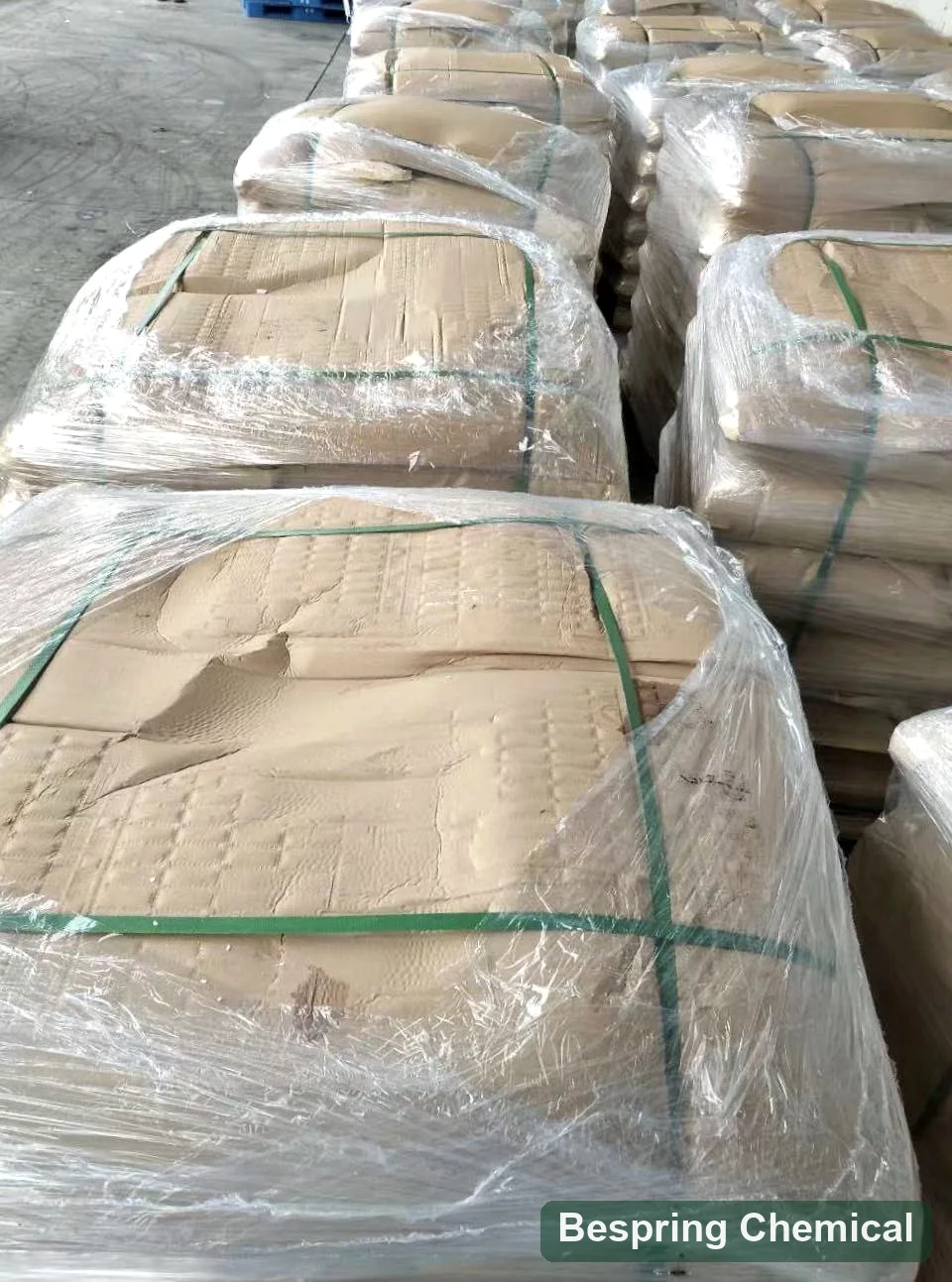
These supplied photographs show sodium benzoate sample forms and a palletized-bag reference.
Specification-led sourcing
Share the product, formulation and logistics details needed to match the offer and qualification documents.
Tell us your grade and destination market so we can confirm which documents are available for your order.
An external reference is not a batch certificate or a Bespring product specification.