Firm, short gel tendency
Potassium is particularly effective for κ gel development. Screen firmness, brittleness, syneresis, melt/set temperatures and synergy with proteins or other gums.

Red-seaweed hydrocolloid · INS 407 / E407
Food grade carrageenan (E407 / INS 407) is a red-seaweed hydrocolloid used for gelling, thickening and stabilization in suitable dairy, dessert and meat formulations. Bespring supplies carrageenan for grade-specific sourcing. Specify refined or processed Eucheuma seaweed identity, predominant kappa, iota or lambda behavior, and the application test method before comparing grades.
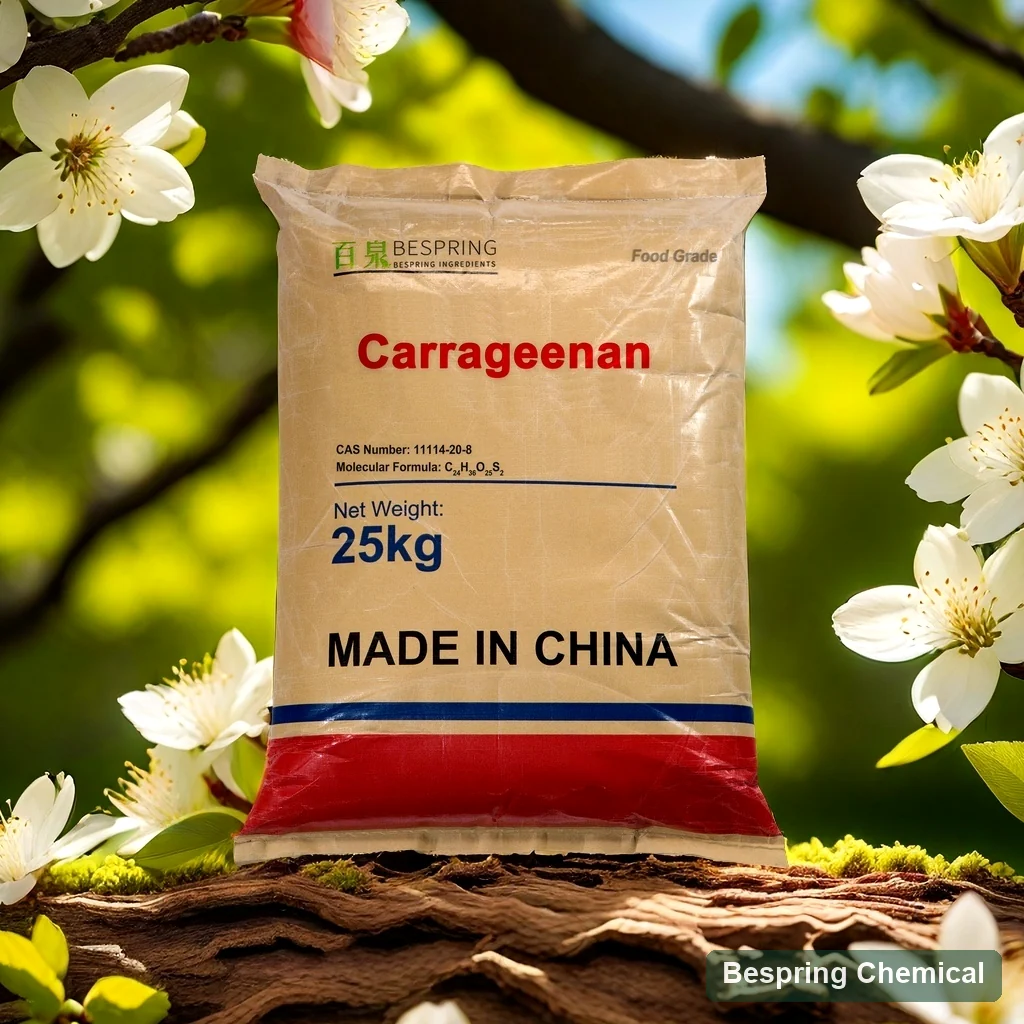
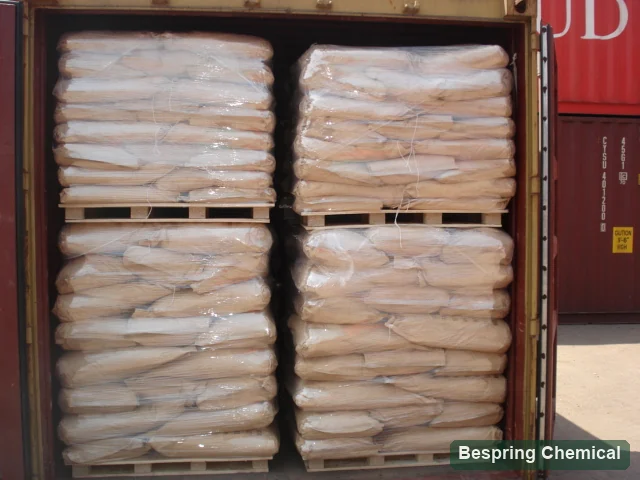
*500 kg MOQ, 25 kg packing and 120 mesh are existing commercial references. Confirm the exact grade, sieve method, source and current offer; INS 407a requires a separate specification.
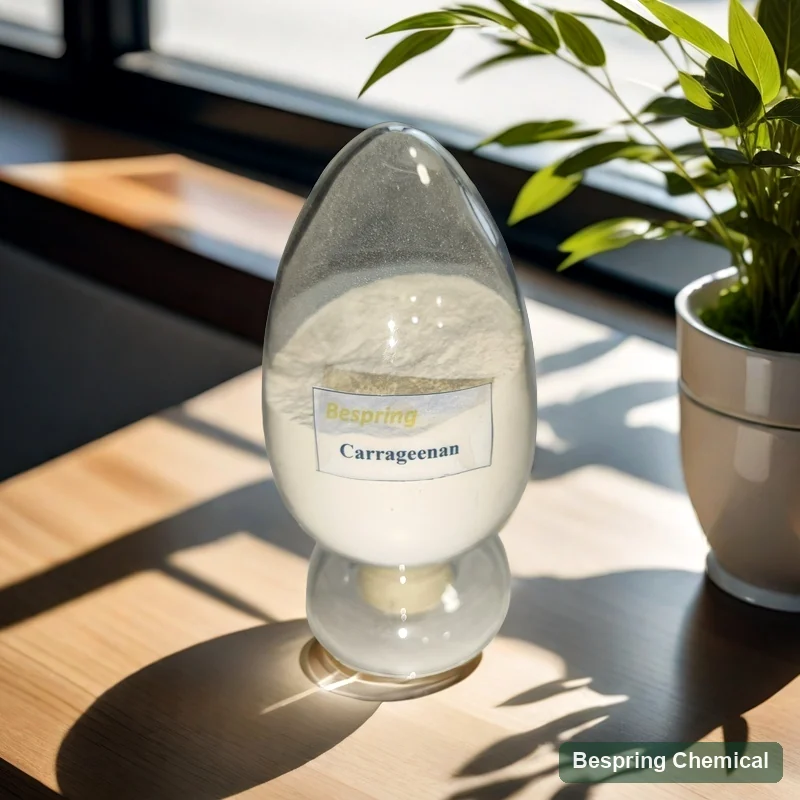
Identity before performance
Carrageenan is a family of sulfated galactan hydrocolloids from specified red seaweeds. The 2007 JECFA carrageenan specification identifies INS 407 and CAS 9000-07-1 and lists thickening, gelling, stabilization and emulsification functions. Polymer composition, counter-ions and any standardizers affect grade selection; one fixed molecular formula, molecular weight or hydrate does not describe all commercial carrageenan.
Processed Eucheuma seaweed (PES), often called semi-refined carrageenan, is a separate INS 407a identity. It has a different processing definition and more retained cellulosic matter. It is not identified merely by a lower gel-strength value. Confirm the additive identity and full ingredient declaration for each offer; food, feed and technical grades require separate qualification.
Choose the polymer response
Potassium is particularly effective for κ gel development. Screen firmness, brittleness, syneresis, melt/set temperatures and synergy with proteins or other gums.
Calcium can support elastic structures in suitable iota systems. Evaluate syneresis, freeze–thaw, ion level and recovery after shear in the actual recipe; these properties are not fixed for all grades.
Predominantly non-gelling behavior suits thickening targets. Define cold/hot process, shear curve, protein interaction and final mouthfeel.
Hydration and gel history control performance
Dry-blend with a suitable carrier or use validated pre-wetting; control shear and powder addition rate.
Refined carrageenan is typically evaluated with heating; JECFA's identity reference uses about 80°C. Exact hydration depends on type, salts and formulation.
Measure potassium, calcium, sodium, milk proteins and other charged ingredients before changing gum level.
Gel set, pumping and filling depend on temperature history, shear during transition and final storage.
Application-specific trials
Measure cocoa/particle suspension, casein interaction, viscosity, heat stability, sediment and over-gelation.
Protein source, calcium fortification, oil emulsion, homogenization and heat process can change response.
Test brine dispersion, cook yield, purge, slice texture, syneresis, salt/phosphate interaction and sensory quality.
Select firm versus elastic texture, opacity, flavor release, cut behavior, melt/set temperature and freeze–thaw need.
Regulatory boundary: INS identity does not authorize every category or dosage. Confirm the destination rule, finished-food category, use level and label declaration.
Commercial reference and grade confirmation
The following existing commercial fields support inquiry screening and an INS 407 comparison. They are not a batch COA or proof of conformity. Separate specifications are needed for refined carrageenan and processed Eucheuma seaweed; the historical gel-strength entries do not establish equivalent grades.
On small screens, swipe the table to read values and confirmation requirements.
| Field | Commercial reference* | Confirm before approval |
|---|---|---|
| Viscosity | ≥5 mPa·s | Matches JECFA minimum only if 1.5% at 75°C method is used |
| Loss on drying | ≤12% | Matches JECFA at 105°C to constant weight |
| pH | 8–11 | Matches JECFA 1% suspension |
| Sulfate / total ash | Each 15–40% | Same stated JECFA dried-basis ranges; sulfate is measured as SO₄²⁻. US sulfate requirement differs; see below. |
| Acid-insoluble ash | ≤1% | Matches INS 407; does not establish INS 407a identity |
| Pb / As / Cd / Hg | ≤5 / 3 / 2 / 1 mg/kg | Matches JECFA carrageenan limits numerically |
| Aerobic plate count | ≤5,000 CFU/g | Matches JECFA; method required |
| Coliform | Absent in 5 g | Does not replace JECFA E. coli negative in 1 g |
| Salmonella | Absent in 10 g | Compare with selected standard's sampling plan |
| Gel strength | Refined ≥1200; semi-refined ≥450 g/cm² | Not comparable without concentration, K/Ca salts, temperature, rest time and instrument geometry |
| Missing JECFA fields | Not supplied | Acid-insoluble matter, residual solvents and identification/type tests required |
Request separate refined-carrageenan and PES specifications, including seaweed/process identity, predominant κ/ι/λ behavior, standardizers, analytical methods and application rheology. Match test concentration, salt composition, heating/cooling, rest time, temperature and instrument geometry before comparing gel values. Clarify the legacy g/cm² force/area convention; it is not automatically equivalent to a penetration-force measurement.
Important standard difference: the cited JECFA sulfate range is 15–40% on a dried basis, whereas 21 CFR 172.620 specifies 20–40% on a dry-weight basis for its defined carrageenan. The existing 15–40% commercial reference is retained; request a batch result and a destination-specific specification rather than assuming US conformity. Sulfate content and total ash are separate measurements.
Additional evidence: the cited JECFA INS 407 specification includes acid-insoluble matter ≤2% and residual ethanol, isopropanol and methanol ≤0.1%, singly or combined; these results are not supplied in the commercial table. Coliform absence in 5 g does not replace E. coli negative in 1 g, and Salmonella absence in 10 g needs method and sampling-plan review. Obtain the offered-grade TDS/specification, SDS, representative and batch COA, ingredient/source declarations and any required certificates; confirm availability and coverage.
CAS 9000-07-1, INS 407 identity, polymer types, solubility, purity and microbiology.
Review Monograph 4INS 407a is separately defined by raw material, processing and retained cellulosic matter.
Review the PES recordGrade-to-application approval
INS 407 or 407a, seaweed species/source, refining process and predominant polymer behavior.
Gel concentration, ion solution, heating/cooling, rest time, temperature and instrument geometry.
Dispersion, hydration, pump/fill shear, set profile, storage and freeze–thaw where relevant.
COA, microbiology, elements, solvents, mesh, moisture, packaging, shelf life and change control.
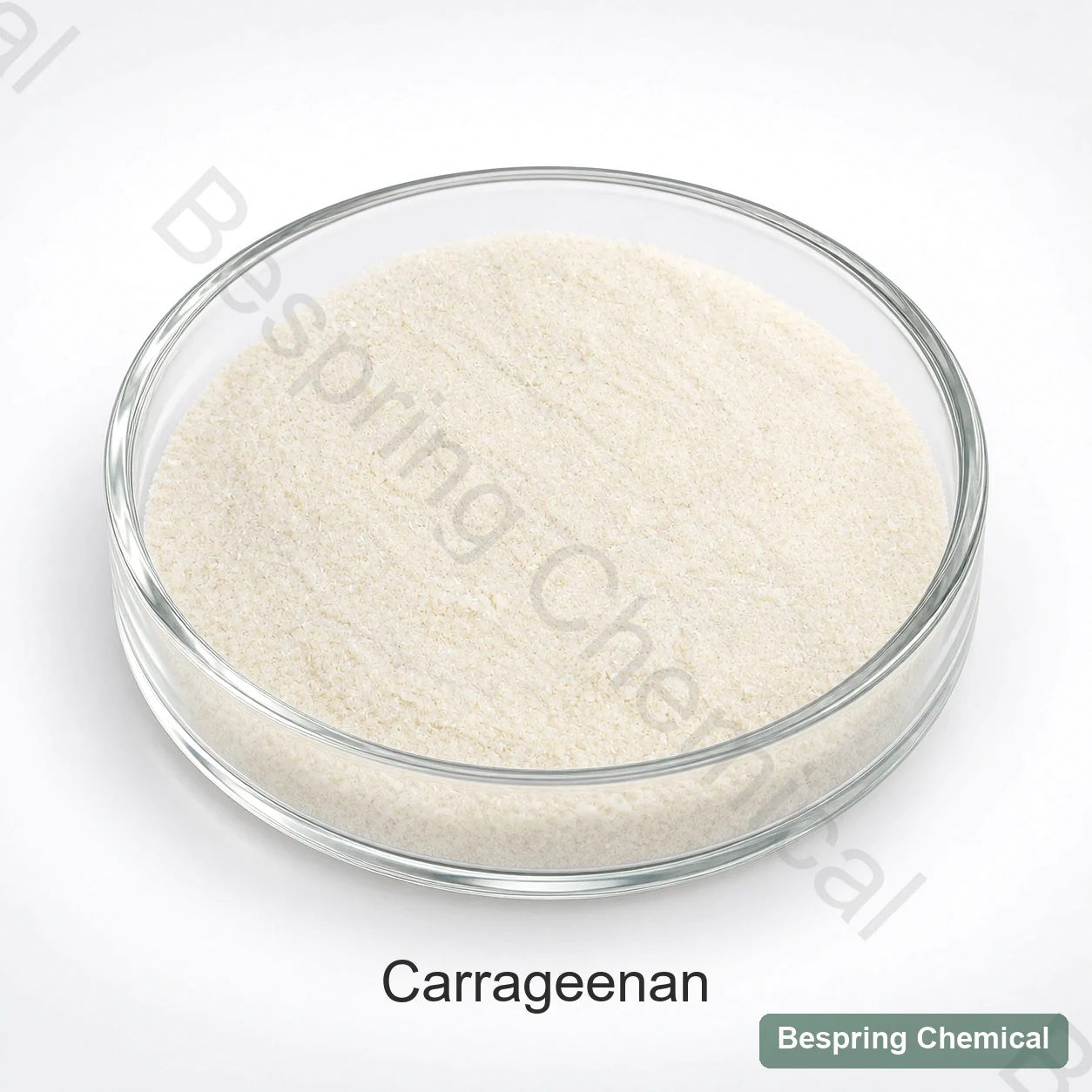
Appearance and packing references
Buyer questions
Begin with the required texture and process: kappa for firmer gel tendencies, iota for elastic gel tendencies and lambda for predominantly non-gelling thickening. Confirm the actual polymer blend, salts, standardizers and food-system trial rather than selecting by type name alone.
No. JECFA defines carrageenan as INS 407 and processed Eucheuma seaweed as INS 407a, with different processing and insoluble-matter characteristics. Specify the required identity and grade; a lower gel-strength result does not itself identify PES.
Only with matching concentration, salt system, heating/cooling, rest time, measurement temperature and instrument geometry. Clarify the reporting unit and force/area convention. The historical refined and semi-refined figures on this page are not equivalent-grade evidence.
No. It is a commercial screening reference and lacks some standard fields. In particular, its sulfate range starts at 15%, while the cited US carrageenan provision starts at 20% on a dry-weight basis. Review the full destination specification, methods and actual batch COA.
No fixed outcome applies. Protein, ions, solids, pH, homogenization and heat history affect the response. Use a control and grade trials to check suspension, viscosity, separation and unwanted gelation in the actual beverage.
Provide INS identity, kappa/iota/lambda target, ingredient declaration, application, ions/protein/solids, process temperatures and shear, rheology method, quality limits, quantity, packaging, destination and delivery terms. Request TDS, SDS, COA and required declarations or certificates with scope confirmed.
Reviewed 2026-10-04 · Technical references: FAO/WHO JECFA, FAO carrageenan guidance and US eCFR.
Related texture systems
Review glucomannan hydration, alkaline gelation and blend synergy.
Compare pseudoplastic thickening and suspension without carrageenan-type gel behavior.
Compare cold-water viscosity, hydration rate and blend behavior.
Compare HM/LM gel mechanisms, pH, soluble solids and calcium windows.
Related application guidance: Processed Cheese Emulsifying Salts & Dairy Stabilizers.
Rheology-led sourcing
Share the real formulation and test method so the offer is not selected by a generic gel-strength number.