Particle distribution
Specify sieve profile, not only a nominal mesh. Particle distribution can change wetting and hydration time. Verify the curve in the proposed method rather than treating mesh alone as a rate guarantee.

Cold-water galactomannan · E412 / INS 412
Food grade guar gum (E412 / INS 412) is a seed-derived galactomannan used to thicken and stabilize suitable foods, including sauces, bakery fillings and frozen desserts. Bespring supplies guar gum for grade-specific sourcing. Compare the complete viscosity method, particle size and hydration profile with your formulation and process before selecting a grade.
*Viscosity: 1% / 2 h commercial reference; confirm the complete method. The 500 kg MOQ and 25 kg pack are existing references, subject to the offered grade and current terms.

Polymer identity
Guar gum—guar flour or gum cyamopsis—is produced primarily from the endosperm of Cyamopsis tetragonolobus seeds. The cited JECFA specification identifies CAS 9000-30-0 and INS 412 and describes a high-molecular-weight galactomannan with an approximate mannose-to-galactose ratio of 2:1.
It is a variable natural polymer, not a single small molecule with a meaningful fixed molecular formula. It has a molecular-weight distribution rather than one molecular weight or defined hydrate. Grade selection depends on purity, particle size, hydration rate, viscosity curve and microbiology. Native food-grade guar, partially hydrolyzed guar, chemically modified guar and formulated gum blends require separate identity and performance review; industrial grades are not food-grade substitutes.
Viscosity develops over time
Finer powder can hydrate faster but also forms surface-wetted lumps more readily. A final two-hour viscosity alone does not reveal production performance.
Specify sieve profile, not only a nominal mesh. Particle distribution can change wetting and hydration time. Verify the curve in the proposed method rather than treating mesh alone as a rate guarantee.
Sugar, salts, proteins and other water-binding solids can slow hydration. Establish the order of addition in the complete formula.
Dry blend with a suitable carrier or use validated wetting. Record mixer type, speed, addition rate and batch geometry to prevent fish-eyes.
Track viscosity at defined intervals and temperature. Faster hydration with heat does not guarantee the same final viscosity after prolonged thermal processing.
Application-specific process targets
Measure pour curve, suspension, cling, pumpability and acid/salt stability across shelf life.
Evaluate water distribution, dough handling, bake loss, softness, filling flow and staling—not “moisture retention” alone.
Test mix aging, overrun, meltdown, iciness, heat shock and interaction with proteins and other stabilizers.
Control segregation, dust, dispersibility, lumping, early viscosity and final mouthfeel under consumer mixing conditions.
Regulatory boundary: Confirm food category, level, label and any origin-specific import controls. 21 CFR 184.1339 lists US identity/purity requirements, functions and category-specific maximum levels on a food-as-served basis. These are legal use conditions, not universal formulation recommendations.
Commercial reference and test methods
These values are inquiry references, not a batch COA or automatic proof of JECFA conformity.
On small screens, swipe the table to read values and confirmation requirements.
| Field | Commercial reference* | Confirm before approval |
|---|---|---|
| Appearance | White to light-yellow powder | Broadly consistent with JECFA description |
| Viscosity | ≥5,000 mPa·s; 1% / 2 h | Not reproducible without water, temperature, dispersion and viscometer settings |
| Loss on drying | ≤15% | Same stated maximum as cited JECFA; confirm 105°C / 5 h and the batch result |
| Total ash | ≤1.5% | Matches JECFA maximum numerically |
| Acid-insoluble matter | ≤7% | Matches JECFA maximum numerically |
| Protein | ≤7% | Tighter than JECFA ≤10%; confirm Kjeldahl N×6.25 |
| “Borate test” | Passes | Ambiguous: separate sodium-borate gel identity from borate-not-detectable purity |
| “Starch test” | Passes | State analyte, method and acceptance result explicitly |
| Lead | ≤2 mg/kg | Matches JECFA maximum numerically |
| Arsenic | ≤3 mg/kg | Commercial field; not listed in cited 1999 JECFA monograph |
| Total viable count | ≤5,000 CFU/g | Matches JECFA maximum numerically |
| Coliform | ≤30 MPN/g | Does not replace JECFA E. coli negative test |
| Missing fields | Not supplied | Salmonella, yeast/mould ≤500 CFU/g, residual ethanol/isopropanol ≤1%, particle distribution and hydration curve |
These commercial values do not establish full JECFA conformity. The protein reference is stricter than the cited JECFA value, while coliform counts cannot stand in for its E. coli test. Ask for the missing microorganism and residual-solvent results and explicit borate/starch methods and acceptance criteria. Sodium-borate gel formation is a laboratory identity test; it is separate from the borate purity test and is not a food formulation instruction.
Functional grade: the ≥5,000 mPa·s reference at 1% / 2 h needs concentration basis, water, temperature, mixing procedure and instrument settings. Specify the required early viscosity as well as final viscosity. mPa·s and cP have equal numerical values, but changing test conditions prevents a meaningful comparison.
Document package: request the offered-grade specification/TDS, SDS, representative and batch COA, botanical origin, ingredient/allergen declarations and any required certificate with its site, product and validity scope. Confirm availability before approval. Agree particle distribution, packaging and liner, storage, shelf life and delivery terms; the page provides no verified storage temperature or shelf-life duration.
Identity, galactomannan source, purity, microbiology and residual-solvent methods.
Review the JECFA specificationCAS 9000-30-0 and technical-effect context including stabilizer/thickener and texturizer.
Review the FDA recordChoose by rheology and process
Rapid cold-water viscosity; hydration rate and lump prevention are key.
Compare pseudoplastic suspension, yield behavior, acid/salt tolerance and mouthfeel.
Compare κ/ι/λ gel or protein interaction; not a direct viscosity substitution.
Compare glucomannan hydration, alkaline gelation and synergy in defined blends.
These links support function and process comparisons, not equal-dose substitution. For dairy formulation context, review the dairy stabilizer and emulsifying-salt guide; a thickener and an emulsifying salt perform different jobs.
Bench-to-line approval
Confirm native food guar, botanical source, origin, INS 412 and destination standard.
Approve particle distribution, bulk density, color, odor, moisture and packaging.
Record early and final viscosity with the complete method and matched water.
Compare lumping, flow, suspension, mouthfeel and process tolerance against a control.
Check viscosity drift, separation, freeze–thaw or heat shock and microbial shelf life.
Align COA, sampling, microbiology, viscosity, mesh, liner and change notification.
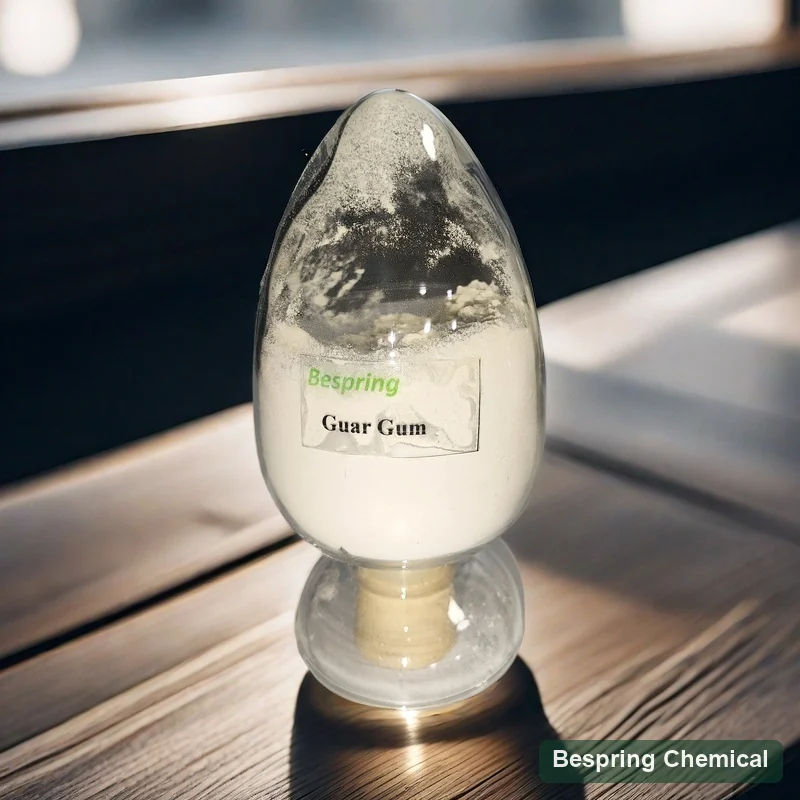
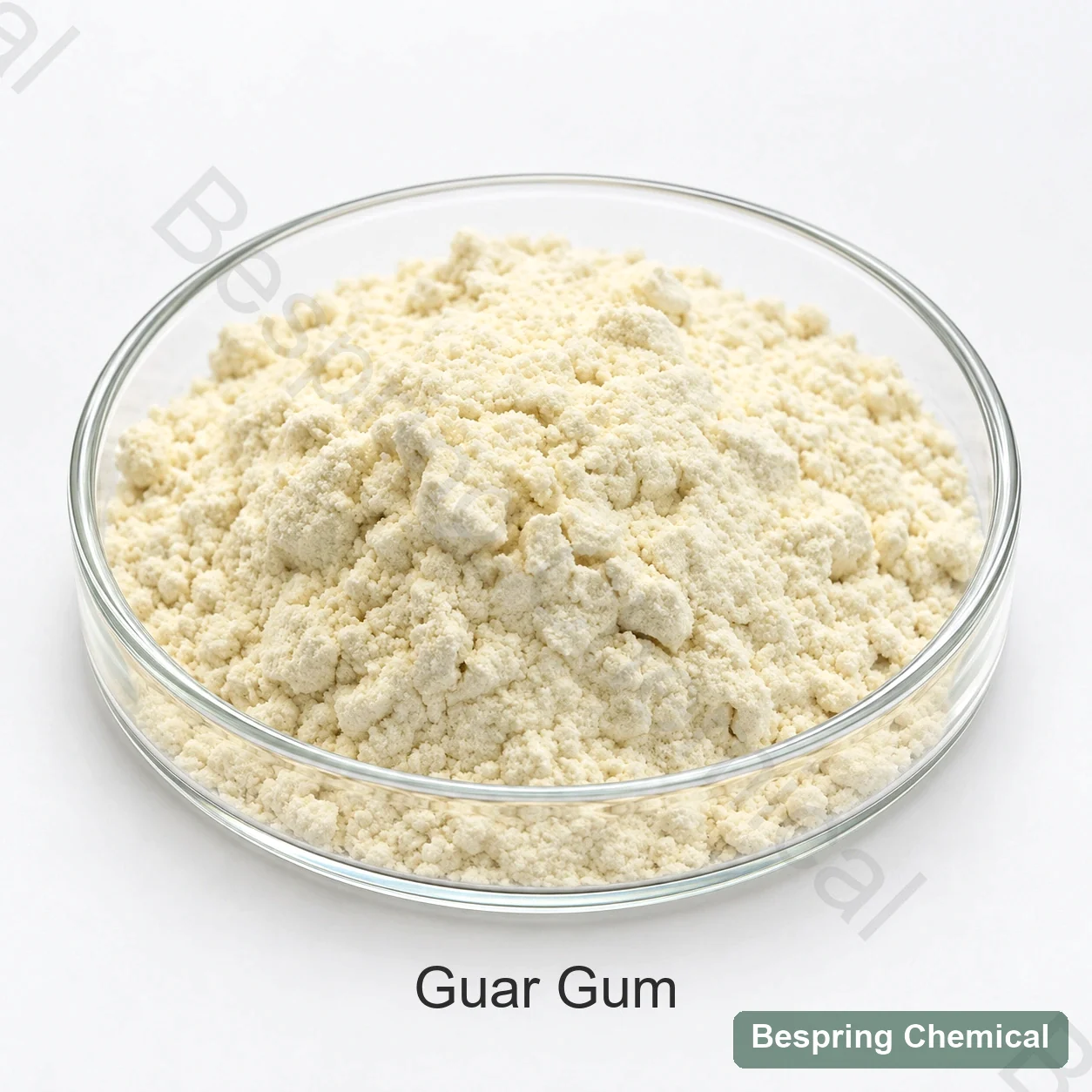
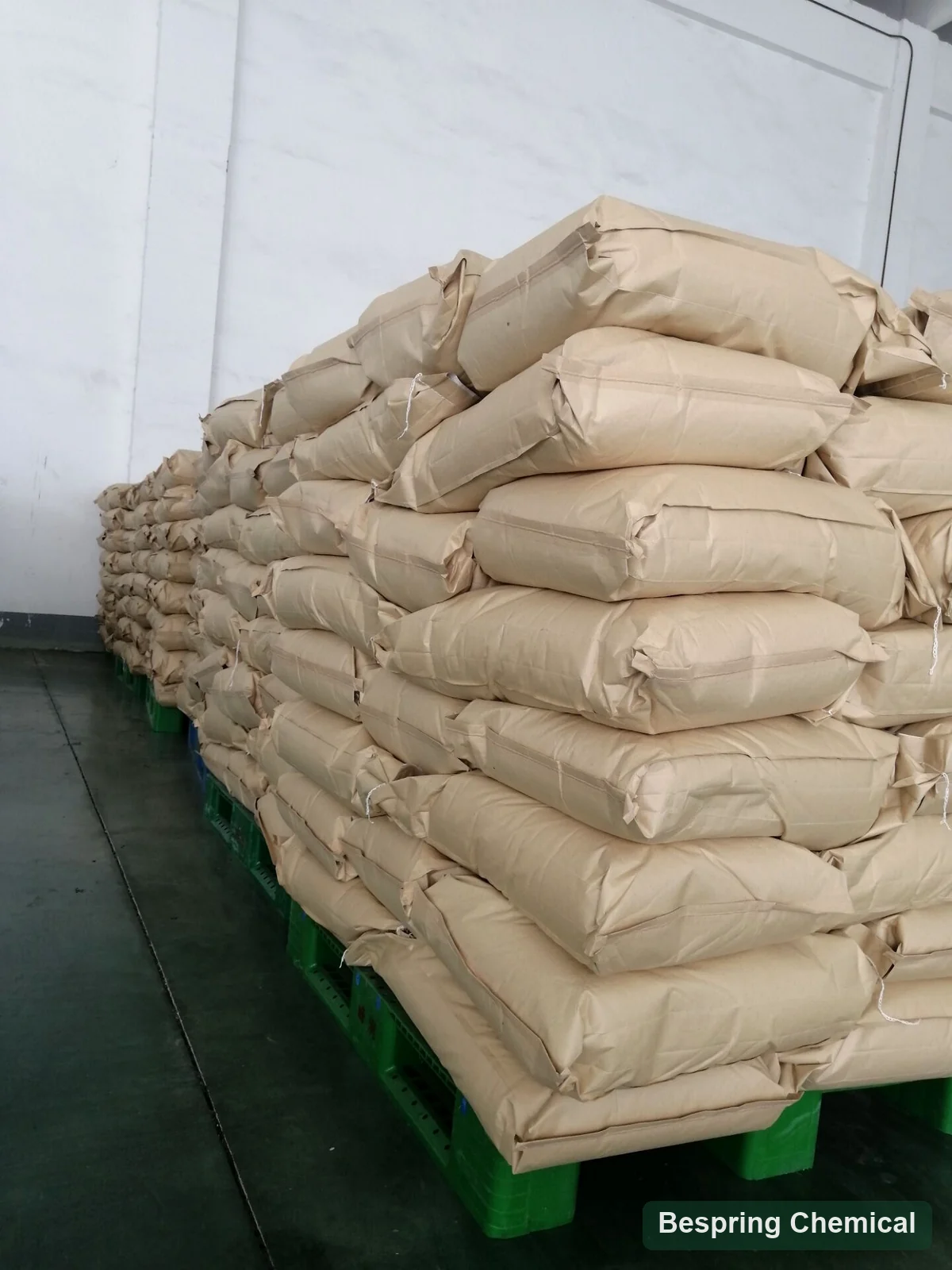
Appearance and storage references
Buyer questions
A time-to-viscosity curve under a specified test method. Particle size, dispersion, water quality, temperature and formulation solids all influence hydration. A mesh label or two-hour final viscosity alone does not establish performance on a short production cycle.
Compare concentration and mass basis, water, temperature, hydration procedure/time, instrument, spindle and speed first. The existing 1% / 2 h reference is incomplete without these details; also compare early viscosity and trials in the real food.
Fast surface hydration can trap dry powder inside a lump. Evaluate controlled powder addition, sufficient dispersion, suitable dry pre-blending and the actual mixing equipment before selecting a faster-hydrating grade.
No. Some values align with the cited monograph, but test wording and missing microbiological/residual-solvent evidence need review. A batch COA must be checked against the agreed grade specification and complete methods.
No. Hydrolysis, chemical modification and blending can change identity, viscosity and intended use. Specify native food-grade E412 for this page and independently qualify any alternative; do not substitute industrial or personal-care grades.
Provide food standard, application, full viscosity method and hydration target, particle distribution, formulation/process, microbiological requirements, quantity, packaging, origin restrictions, destination and delivery terms. Request TDS, SDS, COA and relevant declarations or certificates, with availability and scope confirmed.
Reviewed 2026-10-04 · Identity and specification references: FAO/WHO JECFA and US eCFR.
Hydration-led sourcing
Share the viscosity method and process so the offer is matched by hydration performance—not a headline number.