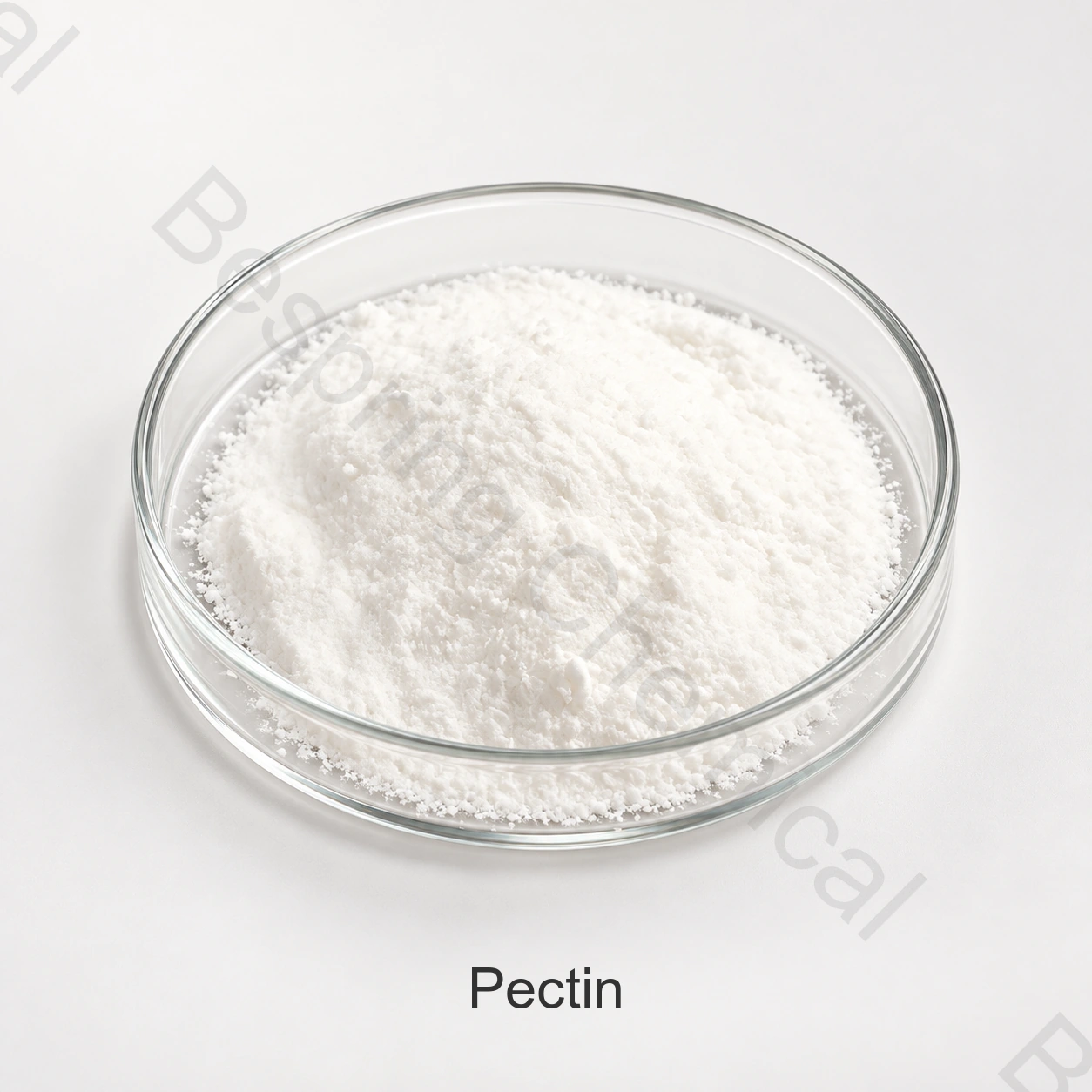
Plant-derived hydrocolloid · E440 / INS 440 · CAS 9000-69-5
Food Grade Pectin
Source pectin by gel mechanism and process—not by the generic name alone. HM, conventional LM and amidated LM grades differ in esterification, calcium response, setting behavior and formulation window.
Include product, soluble solids/Brix, pH, calcium, set/deposit process and target texture.
Mechanism firstSugar-acid or calcium-mediated gel
Process matchedSet rate must fit filling or depositing time
Composition disclosedPectin, standardizing sugar and buffer salts
Source evidenceCurrent specification and COA on request
Product identity
What is food grade pectin?
Pectins consist mainly of partial methyl esters of polygalacturonic acid and their ammonium, sodium, potassium or calcium salts. They are extracted in an aqueous medium from appropriate edible plant material, commonly citrus peel or apple material. Amidated pectin is additionally treated with ammonia under alkaline conditions.
Commercial pectin may be standardized for consistent application performance. The exact product can therefore include approved sugar and buffer-salt components; buyers should request full composition and label guidance instead of assuming every bag is unstandardized pectin.
The main technical decision
HM, LM and amidated LM pectin are not interchangeable
Degree of esterification (DE), degree of amidation (DA), calcium reactivity and standardization help predict behavior, but the finished product and process still determine approval.
DE ≥50%
High-methoxyl pectin (HM)
Evaluated primarily for sugar-acid gel systems and for selected protein-stabilization or viscosity functions.
Define soluble solids/Brix and final pH
Select rapid, medium or slow set for the fill/deposit window
Confirm SAG or other gel-strength method and setting temperature
Test fruit solids, acids, sugars and cook profile together
DE <50%
Low-methoxyl pectin (LM/LMC)
Evaluated for calcium-mediated gels, including lower-soluble-solids fruit systems where calcium level and reactivity are controlled.
Measure native and added calcium, not only recipe dosage
Specify calcium reactivity and target gel texture
Control pH, solids, sequestrants and heating/cooling
Check syneresis and stability through shelf life
E440(ii)
Amidated LM pectin (LMA)
Amidation changes calcium response and the working window. DA must be stated together with DE and application performance.
Confirm degree of amidation and current regulatory identity
Map calcium tolerance and setting temperature
Determine whether the gel is thermoreversible under actual conditions
Do not substitute for conventional LM on equal weight alone
Terminology boundary: “rapid set,” “slow set,” “gummy pectin,” “yogurt pectin” and “bakery pectin” are performance/market labels, not complete specifications. Require DE/DA, composition, test methods and a matched application trial.
Start with the formulation constraints
Pectin selection map
High soluble solids + acidic gel
Start screening an HM grade, then choose setting rate around cook, transfer, filling and cooling time.
Lower solids + controlled calcium
Screen LM or LMA by calcium reactivity, pH, sequestration and required gel texture.
Acid protein stabilization
Use an application-specific pectin; check protein level, pH path, heat, homogenization, sediment and serum separation.
Deposited confectionery
Match gel onset to kettle/depositor residence, temperature and acid addition so the mass fills before setting.
No universal pH, Brix or calcium numberSupplier ranges are starting points. Fruit buffering, acid type, sugar composition, calcium availability, sequestrants, solids measurement and process history shift the real gel window.
Application-specific qualification
Where food pectin is evaluated
These paths explain what to test; they are not universal permissions, recipes or dosage recommendations.
Jams, jellies and fruit preparations
Set target Brix, pH, gel strength, spreadability and fruit suspension. Validate acid addition, endpoint solids, filling temperature, set time, syneresis and storage texture.
Gummies and confectionery gels
Match HM set rate or LM/LMA calcium response to depositing time. Test solids, acid timing, gel temperature, demoulding, drying, coating and bite throughout shelf life.
Acid dairy and plant-protein drinks
Evaluate protein protection through acidification, heat and homogenization. Measure viscosity, sediment, serum separation, mouthfeel and stability; a generic jam grade is not automatically suitable.
Bakery fillings and glazes
Balance pumpability, bake stability, fruit suspension, water migration, sheen and clean cut. Test freeze-thaw or bake cycles where relevant.
Qualification fields—not invented product limits
Build the pectin specification around performance
No approved Bespring pectin specification was available for public publication. The following fields should be obtained for the exact offered grade rather than replaced with generic ranges.
Pectin purchasing specification checklist
Area
Required fields
Why it changes selection
Identity
E440(i) non-amidated or E440(ii) amidated; HM/LM/LMA; botanical source
Separates regulatory identity and gel mechanism
Modification
DE, DA where applicable, calcium reactivity
Predicts set behavior but does not replace application tests
Performance
Set category, SAG/gel strength, setting temperature, viscosity with methods
Matches cook, filling, deposit and cooling window
Composition
Pectin content, standardizing sugar/carrier, buffer salts, calcium salts or sequestrants
Controls dosage comparison, labeling and reproducibility
Physical
Appearance, particle distribution, dispersibility, bulk density
Affects dosing, dust, lumping and dissolution
Purity
Galacturonic acid, loss on drying, insolubles/ash, SO2, nitrogen, residual solvents, elemental limits
Needed for the selected reference standard and destination
Microbiology
TPC, yeasts/moulds, E. coli and market/application-specific pathogens
Must reflect process risk and destination requirements
Commercial
Packing, shelf life, storage, MOQ, quantity, origin, Incoterm, lead time
Connects technical approval to deliverable supply
JECFA identity and assay reference
The JECFA specification provides definitions, ≥65% galacturonic-acid assay on the stated basis and methods for DE/DA and residual solvents. It does not prove an offered grade's application performance.
EU Regulation 2026/196 updates E440(i)/(ii) definitions, toxic-element and microbiological criteria. Destination and transition dates must be checked for each shipment.
Compliance boundary: a JECFA or EU identity specification does not authorize every food application. Check the exact food category, use condition, label declaration and destination-market rules separately.
Dissolve first, trigger the gel at the right time
Pectin process trial
Incomplete dispersion and premature gelation are common reasons a suitable pectin appears to fail.
1
Fix the product target
Record Brix/solids, pH, calcium, texture, set time, filling/deposit temperature and shelf conditions.
2
Disperse without lumps
Use the supplier-approved addition route, often separating particles with a compatible dry blend before controlled addition into adequate agitation.
3
Complete hydration
Control water availability, temperature, shear, time and ingredient order before high sugar, calcium or acid creates a restrictive environment.
4
Trigger and deposit
Add acid or calcium according to the selected mechanism and keep the transfer/deposit operation inside the measured working window.
5
Measure the cooled product
Evaluate set time, gel strength, spread/bite, syneresis, cut, filling stability and sensory release after defined equilibration.
6
Repeat through shelf life
Include storage temperature, freeze-thaw or baking where relevant, and compare at least one representative production-scale batch.
Storage and handling
Protect pectin and its standardized blend
Keep dryStore sealed and protect hygroscopic powder from humidity, contamination, pests and packaging damage.
Follow source conditionsUse the current specification/SDS for temperature, shelf life and stock rotation; do not infer one universal limit.
Control substitutionsChanging source, grade or standardization can shift gel timing. Revalidate before production release.
Buyer questions
Food grade pectin FAQ
What is the difference between HM and LM pectin?
HM pectin has DE of at least 50% and is commonly screened for high-solids acid gel systems. LM pectin has DE below 50% and is commonly screened for calcium-mediated gels. Actual grade approval also depends on set characteristics, pH, solids, calcium and process.
Is amidated pectin the same as ordinary LM pectin?
No. Amidated LM pectin is E440(ii) and has amide groups measured as degree of amidation. Amidation changes calcium response and working behavior, so DE, DA and application performance must all be confirmed.
Does rapid-set pectin make a stronger gel?
Not necessarily. “Rapid” describes setting behavior, not automatically final gel strength. Select set rate to fit cooking, transfer, filling/deposit and cooling, then measure the final texture with the supplier's stated method.
Is commercial pectin always 100% unstandardized pectin?
No. Commercial grades may be standardized with sugars and buffer salts for consistent performance. Request the complete composition, active basis and label declaration for cost-in-use and supplier comparisons.
What should a pectin RFQ include?
State application, HM/LM/LMA or desired mechanism, Brix/solids, pH, calcium, DE/DA, set time/temperature, target texture, process, quantity, packing, destination and required documents.
Substantive content review: 2026-08-22 · Independent identity references: FAO/WHO JECFA, Codex GSFA and current EU specifications.