Buffering capacity
DKP can resist pH movement within a formulation-dependent window. Measure titratable acidity and pH through processing and storage, not only after initial mixing.

Dibasic potassium orthophosphate · E340(ii) / INS 340(ii)
Food grade dipotassium phosphate (DKP) is a water-soluble potassium orthophosphate used as a buffering agent and sequestrant. Bespring supplies the anhydrous K2HPO4 product described here for food-ingredient sourcing. Specify the food standard, impurity limits, physical form and application so the offered grade can be reviewed before purchase.
*Commercial reference values from the available DKP sheet. Confirm the offered-grade specification, MOQ and shipment terms in the quotation.
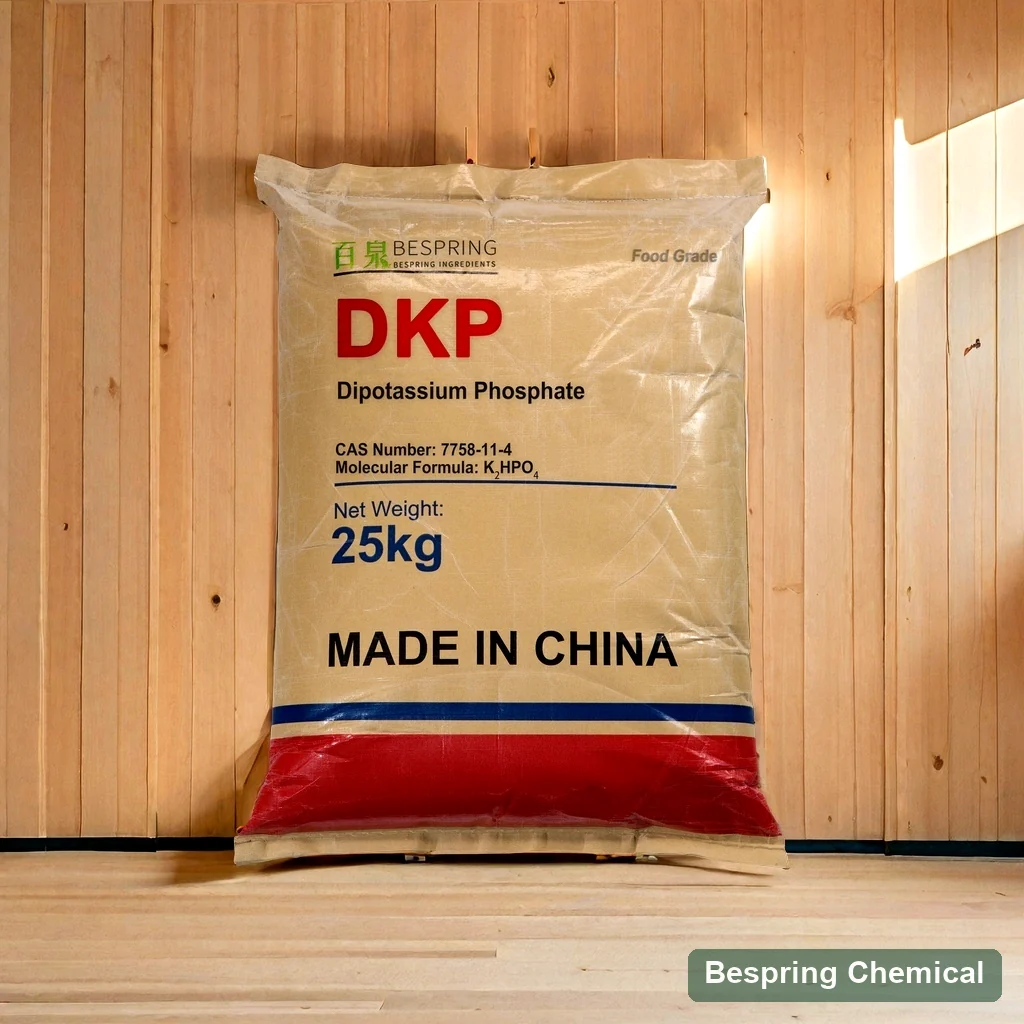
Product identity and food grade
Dipotassium phosphate, also called dipotassium hydrogen phosphate, potassium phosphate dibasic or dibasic potassium phosphate, is K2HPO4. This page describes the anhydrous form: CAS 7758-11-4, molecular weight 174.18 g/mol and INS 340(ii) / E340(ii). The JECFA DKP monograph identifies this composition; hydrated forms require their own identity and specification.
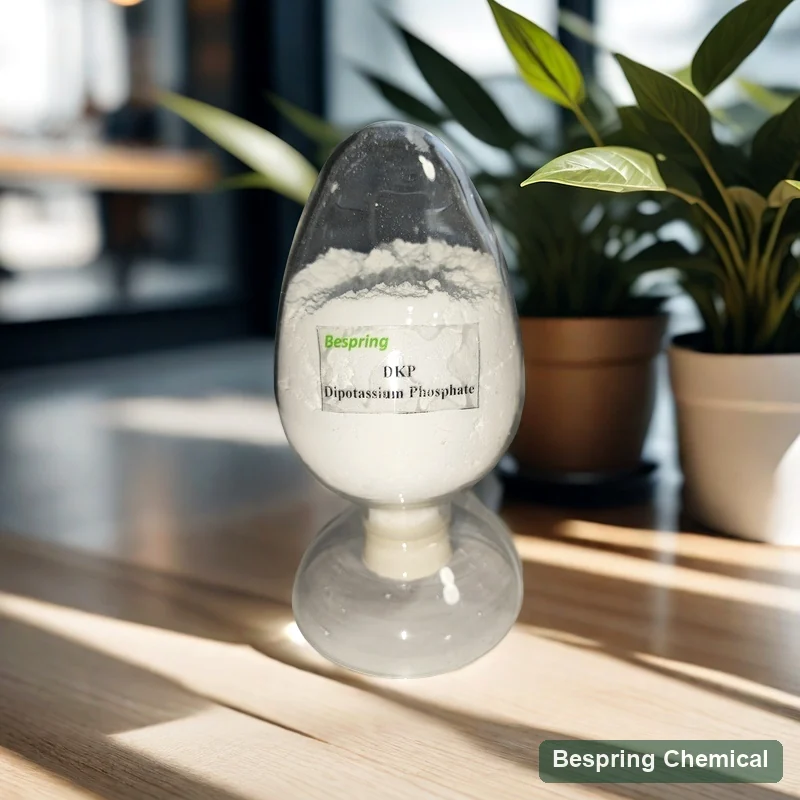
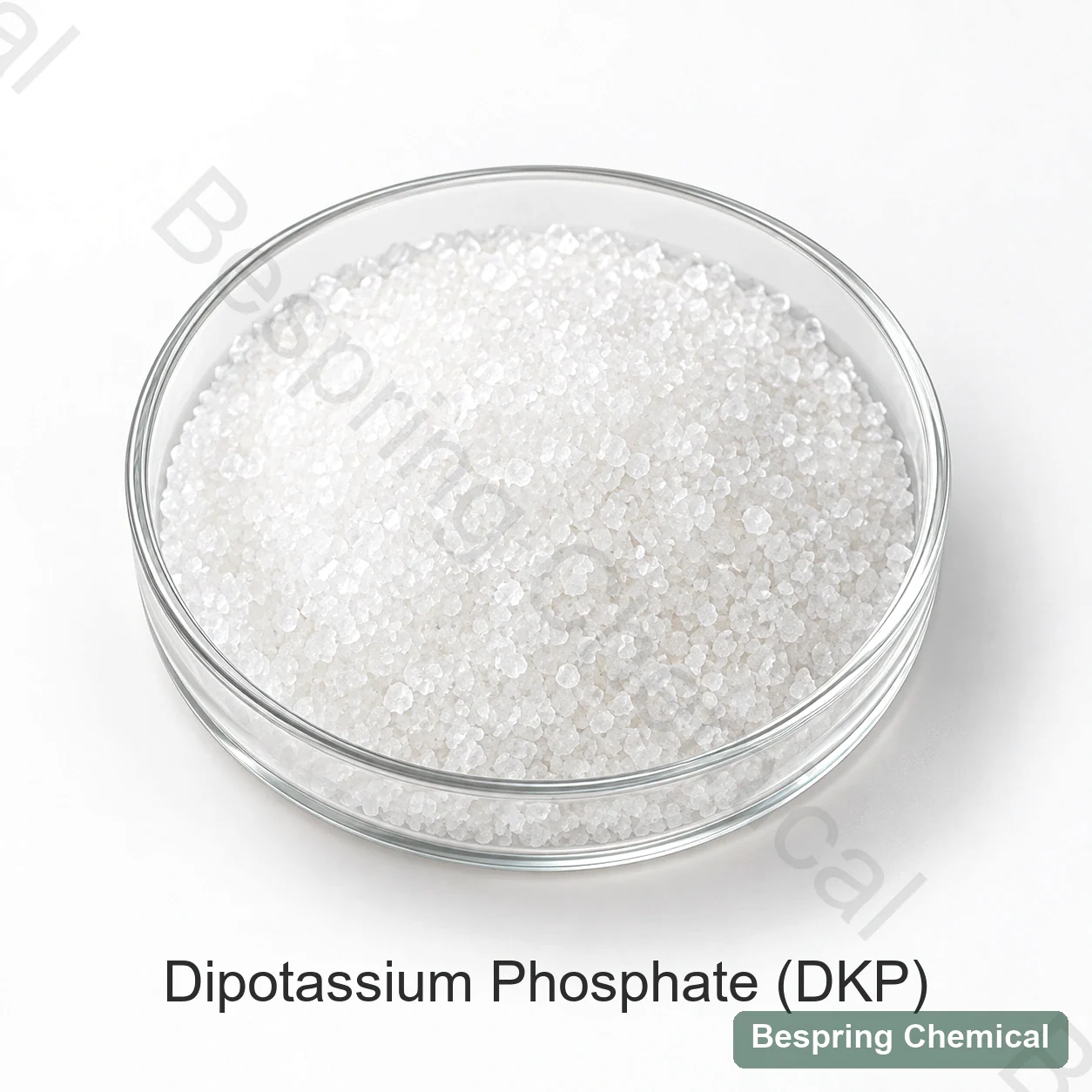
JECFA describes colourless or white granules, crystals or masses and notes that DKP is deliquescent. It lists buffering agent, sequestrant and yeast-food functions. Confirm the offered powder or granular form and particle-size requirements rather than treating the reference images as a guaranteed size distribution. Food grade must be supported by the grade documents; the same chemical name does not establish suitability of a technical or fertilizer grade.
A buffer component—not a universal pH setting
The phosphate acid/base balance, concentration, starting pH and other acids or salts determine the response of the complete formulation. The JECFA pH reference is 8.7–9.3 for a 1 in 100 solution: it is an identity/purity test, not the pH range guaranteed for a finished food.
DKP can resist pH movement within a formulation-dependent window. Measure titratable acidity and pH through processing and storage, not only after initial mixing.
DKP supplies both potassium and phosphate. Calculate elemental contribution from the certified assay and total formula; do not infer a nutrition claim from ingredient presence.
Phosphate can alter soluble calcium and other mineral equilibria. Hardness, fortification salts, proteins and heat can shift clarity, sediment and texture.
Because DKP is freely water-soluble and deliquescent, water quality, addition order, dry-blend humidity, liner integrity and caking control belong in qualification.
Protein beverages require system testing
Buffer salts may support pH and mineral management during high-temperature processing, but DKP is not automatically beneficial in every protein beverage.
Record MPC/MCC, whey or plant protein source, mineral composition, prior heat history and hydration. Poor protein hydration can cause graininess or settling independent of DKP.
Measure soluble and total minerals. DKP can change casein-mineral equilibria; excessive disruption may alter viscosity or release proteins and minerals from micelles.
Compare no-DKP and graded-DKP controls through HTST, UHT or retort conditions and shelf life. Track fouling, coagulation, sediment, viscosity, color and pH drift.
Check mineral taste, mouthfeel, color and label positioning together with stability. A technically stable drink can still fail sensory or nutrition requirements.
Evidence boundary: the 2024 Journal of Dairy Science study compared 0 and 0.15% DKP (wt/wt of the beverage) in fresh liquid MCC/MPC systems containing 7.5% milk protein. DKP increased soluble protein, calcium and phosphorus, while these beverages remained heat stable without it. The work included HTST and direct-steam-injection UHT treatments and refrigerated storage. This experimental level is not a recommended dose, a legal allowance or evidence of stability in every dairy or plant-protein drink.
Commercial reference and test basis
These commercial limits are preserved from the available Bespring DKP sheet. They are not batch results or proof of compliance with a selected standard. Impurity limits originally expressed as percentages are shown in mg/kg on a mass basis; confirm sample preparation, reporting basis and methods for the offered grade.
On small screens, swipe the table to read the qualification notes.
| Field | Commercial reference* | Qualification note |
|---|---|---|
| K2HPO4 assay | ≥98.0% | JECFA: ≥98.0% after drying. The commercial sheet does not state its reporting basis; confirm it and the assay method. |
| P2O5 | 39–42% | Reported as P₂O₅, not elemental phosphorus. Confirm the as-supplied or dry/anhydrous basis and analytical method. |
| pH | 8.7–9.3 | JECFA: 8.7–9.3 for a 1 in 100 solution. The commercial concentration and measurement temperature are not stated. |
| Loss on drying | ≤2.0% at 105°C | JECFA: ≤5% at 105°C for 4 h. Commercial drying duration is not stated, so the numerical limits alone do not establish equivalence. |
| Insoluble matter | ≤0.1% | JECFA: ≤0.2% water-insoluble matter. Confirm that the commercial field uses the same test and reporting basis. |
| Fluoride | ≤10 mg/kg | JECFA: ≤10 mg/kg as fluoride. Confirm the offered-grade method and batch result. |
| Arsenic | ≤3 mg/kg | JECFA: ≤3 mg/kg as arsenic. Confirm element-specific testing. |
| Lead | ≤5 mg/kg | The reference limit exceeds JECFA’s ≤4 mg/kg for lead; it cannot guarantee that requirement. |
| Heavy metals as Pb | ≤20 mg/kg | Aggregate “as Pb” field; it is not a separate lead result or evidence that every individual element limit is met. |
| Cadmium / mercury | Each ≤1 mg/kg | Commercial fields; confirm destination limits and methods |
The commercial lead limit is ≤5 mg/kg, while the cited JECFA monograph specifies ≤4 mg/kg. This difference does not show that every batch fails, but the commercial limit alone cannot guarantee the JECFA requirement. Request a signed specification aligned with the selected standard, the method and actual batch COA. Complete the identity tests and remaining purity checks as well as the fields shown here.
Standards can differ. The original 2012 EU E340(ii) specification text gives P₂O₅ at 40.3–41.5% on an anhydrous basis and arsenic and lead at ≤1 mg/kg each. Those limits are narrower than the commercial P₂O₅, arsenic and lead references above. This is a version-specific comparison; confirm the currently applicable consolidated text and food-category conditions before EU supply approval.
The cited monograph provides identity and purity requirements, including assay after drying and element-specific limits. Its assay uses acid–base titration of a dried sample.
Open the DKP monographThe FDA inventory identifies DKP and lists emulsifier salt, nutrient supplement, pH-control, sequestrant and stabilizer/thickener effects.
Review the FDA entryFor US food use, 21 CFR 182.6285 recognizes dipotassium phosphate as safe when used in accordance with good manufacturing practice. This is not product approval or permission for every food and market. Technical functions, ingredient purity and permitted use must be assessed separately.
Select by acid/base and cation balance
These orthophosphates are not equal-weight substitutes. Compare molar composition, solution pH, buffer need, potassium/sodium target and legal identity.
KH2PO4; consider as the acidic partner in a potassium-phosphate buffer.
K2HPO4; dibasic buffering, potassium/phosphate and mineral-control intent.
K3PO4; higher alkalinity requires separate pH and sensory qualification.
Na2HPO4; compare sodium/potassium contribution and actual buffer performance.
Bench-to-line approval
State anhydrous food grade K₂HPO₄, CAS 7758-11-4, destination, food category and selected standard.
Confirm assay basis, pH concentration, moisture method, insolubles and element-specific limits.
Measure pH response and titratable acidity in the complete formula, not only water.
Compare no-DKP and graded-DKP samples under matched mixing, heating and storage.
Track protein stability, sediment, viscosity, mineral balance, taste, color and nutrition totals.
Request the TDS, SDS, representative COA and lot COA against the approved specification. Confirm particle form, caking, packing and storage. If certification or allergen/source declarations are required, verify their availability and scope for the offered grade and relevant site.
Appearance and storage references
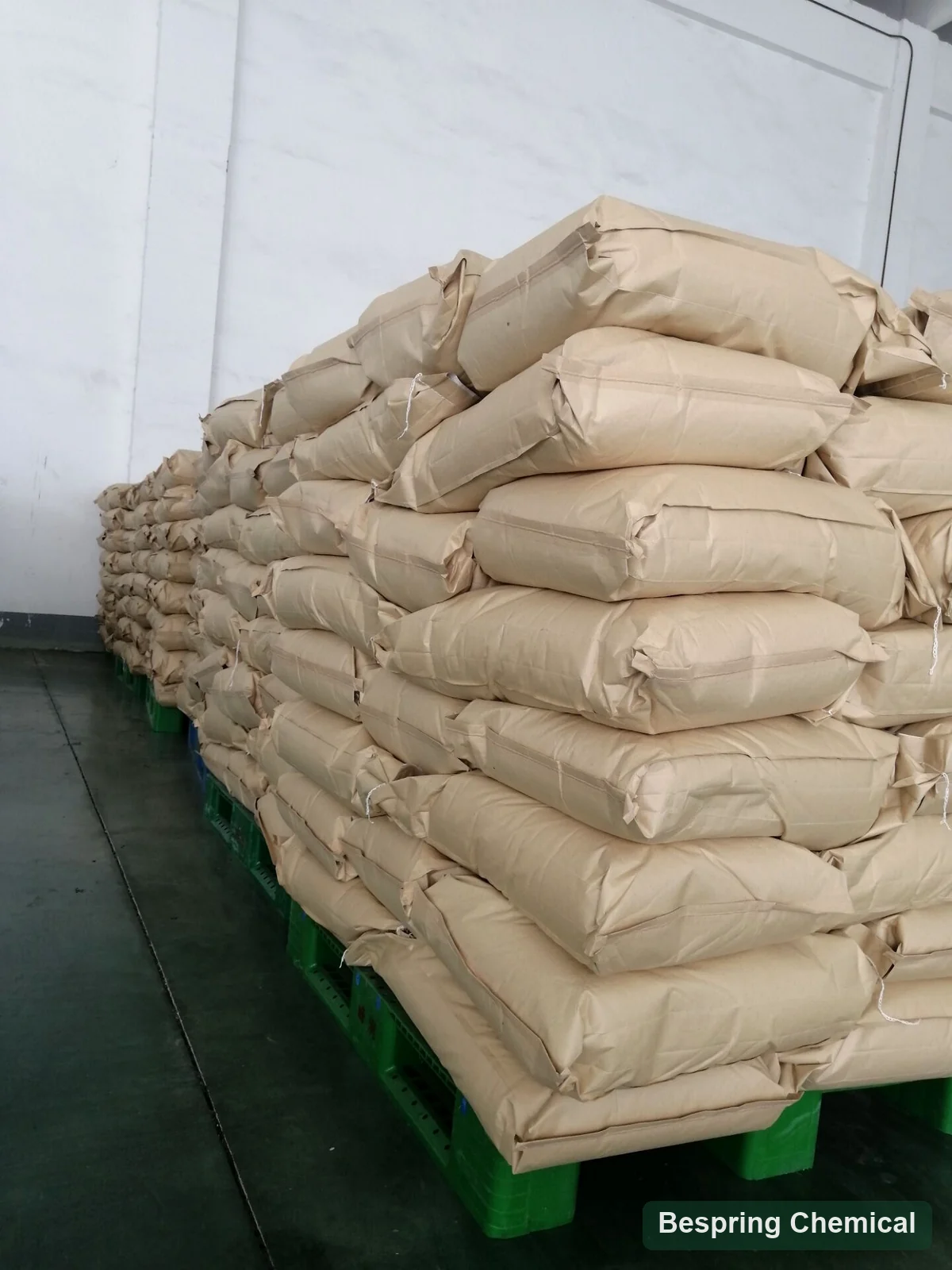
The available DKP sheet lists 25 kg bags, a 500 kg MOQ and a 22 MT / 20' FCL loading reference. Confirm these terms, liner, pallets and actual load plan in the quotation. Store in a cool, dry, ventilated place away from sunlight, heat and humidity; the sheet specifies a storage temperature not exceeding 30°C. Keep the pack closed to limit moisture uptake. Confirm shelf life and handling after opening in the offered-grade documents.
Buyer questions
This page describes anhydrous dipotassium phosphate, K₂HPO₄, CAS 7758-11-4, also called dipotassium hydrogen phosphate. JECFA lists buffering, sequestrant and yeast-food functions. The food standard, physical form and permitted use still require grade- and market-specific review; a hydrated or technical grade is not an automatic equivalent.
No. Its lead limit is ≤5 mg/kg, compared with ≤4 mg/kg in the cited JECFA monograph. An individual batch may be lower, but a suitable signed specification, confirmed methods and batch COA are needed. Assay basis, pH concentration and drying duration also require confirmation.
No. JECFA gives that range for a 1 in 100 solution. The finished-food response depends on concentration, other acids and salts and the complete formulation. Measure pH and titratable acidity under the actual process and storage conditions.
No. Protein source, hydration, soluble minerals, calcium, pH, heat process and storage all matter. Compare the candidate grade with a no-DKP control. A result in one milk-protein system does not establish the same result in a plant-protein drink or a different shelf-life process.
DKP is dibasic K₂HPO₄; MKP is the more acidic KH₂PO₄. Their potassium-to-phosphate ratio, solution pH and buffering behavior differ. Select by formulation and permitted use rather than substituting equal weights.
Provide anhydrous food grade, destination and food standard, assay basis, critical impurity limits, physical form, application and process, quantity, packaging and delivery terms. List required TDS, SDS, COA and declarations. Confirm commercial terms and any certificate scope in the actual offer.
Reviewed 2026-10-04 · Technical references: FAO/WHO JECFA, US FDA/eCFR, the cited EU specification version and dairy-beverage research.
Continue formulation qualification
Review pH, minerals, clarity, protein, heat treatment and sensory targets. See the dairy and plant-beverage phosphate screening guide for trial planning.
Connect phosphate choice with calcium, casein, heat, shear and cooling.
Evaluate a defined blend where buffer range and mineral response must be balanced.
Formulation-led sourcing
Request a quotation and the offered-grade documents. Share the target food standard, buffer requirement and process so the grade can be reviewed against your specification and formulation.