China-based chemical products supplier Exporting to 60+ countries

Food grade polyol · D-glucitol · CAS 50-70-4

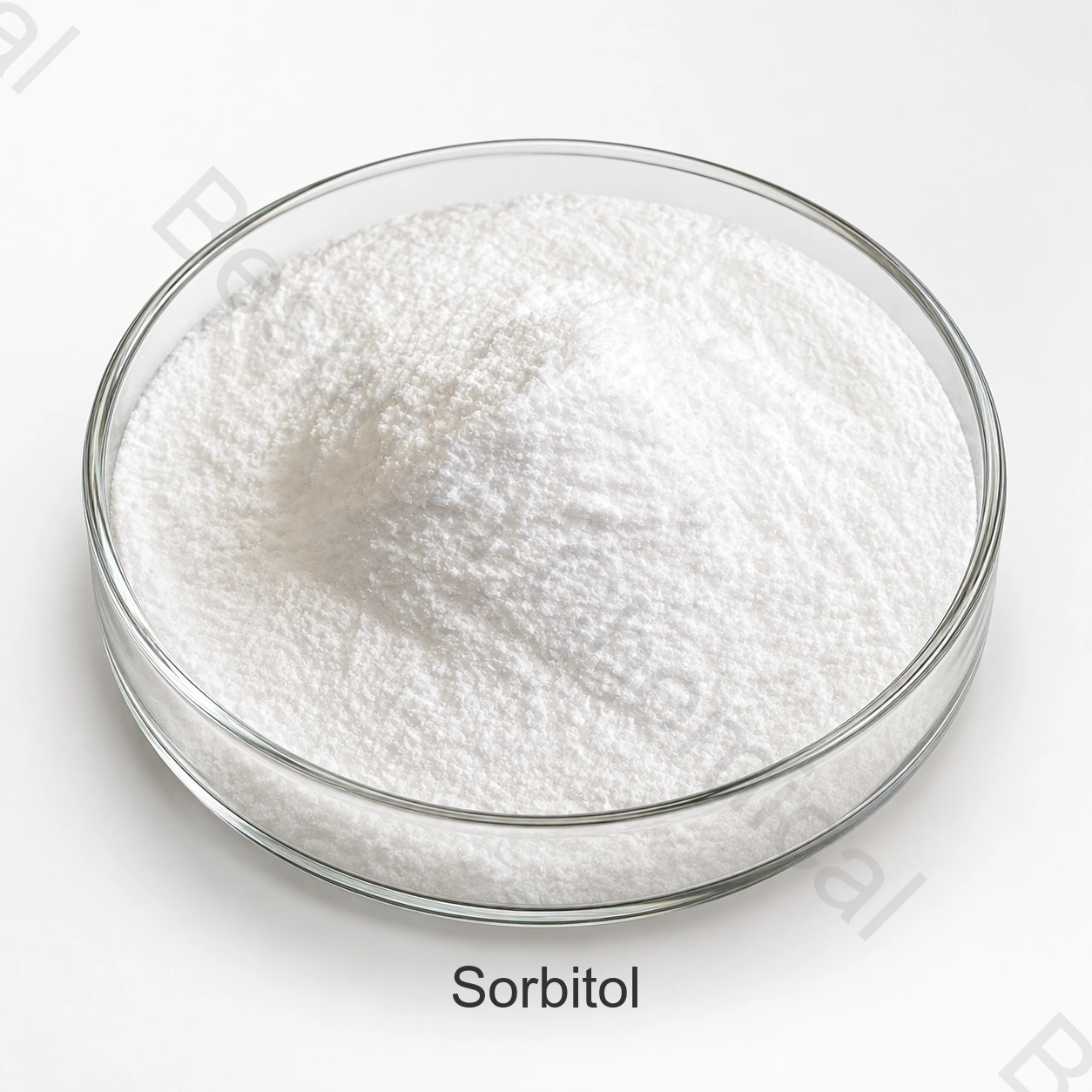
Food Grade Sorbitol

Source the correct sorbitol form for sweetness, bulk, moisture management and texture. Crystalline sorbitol E420(i) and sorbitol syrup E420(ii) are separate purchasing specifications—not interchangeable labels for one product.

Crystalline identity
INS / E420(i)
Syrup identity
INS / E420(ii)
Formula (D-sorbitol)
C6H14O6
Offered specification
Confirm with sales

State crystalline or syrup, solids/composition target, application, quantity and destination.

Assorted powdered and liquid food ingredient samples
Form firstCrystalline and syrup RFQs are separated
Specification-ledComposition and methods must be source-specific
Application reviewMoisture, texture and sweetness tested together
Batch evidenceRequest current specification and COA

Product identity

What is food grade sorbitol?

Sorbitol, also called D-glucitol, is a polyol used in foods as a sweetener, humectant, bulking agent, texturizer, stabilizer and sequestrant. The FAO/WHO JECFA monograph identifies crystalline sorbitol as INS 420(i), CAS 50-70-4.

Sorbitol syrup is a separate food-additive identity, INS 420(ii). It is an aqueous polyol preparation whose non-sorbitol fraction can vary with the feedstock and process. Buyers therefore need the exact form, composition basis and source-specific specification—not only the word “sorbitol.”

The decisive purchasing choice

Crystalline sorbitol vs. sorbitol syrup

Search results often combine “sorbitol powder,” “sorbitol 70% solution” and “non-crystallizing sorbitol,” but these terms describe materially different handling and formulation questions.

E420(i) / INS 420(i)

Crystalline sorbitol

Choose a dry form when water addition is undesirable or when dry blending, particle behavior and dissolution are important.

  • Confirm D-sorbitol and total glycitols on an anhydrous basis
  • Specify powder, crystal, granule or required particle-size range
  • Evaluate flow, caking, dust, dissolution and blend segregation
  • Control moisture because crystalline sorbitol is hygroscopic
E420(ii) / INS 420(ii)

Sorbitol syrup

Choose an aqueous form when liquid handling and pre-dissolved solids fit the process. “70%” commonly refers to total dry substance, not automatically 70% pure D-sorbitol in the finished liquid.

  • Confirm total solids and sorbitol on the stated dry or as-is basis
  • State crystallizing or non-crystallizing requirement where relevant
  • Review mannitol, reducing sugars and other polyols/saccharides
  • Evaluate viscosity, pumping, temperature and microbiological controls

Availability boundary: this page does not assert that every form or composition is always available. Bespring sales must match the offered source and current signed specification to the RFQ.

Function-led application screening

Where sorbitol performance must be tested

Sorbitol contributes more than sweetness. Changing form or replacing sucrose by weight can alter water, total solids, texture, freezing behavior and process conditions.

Chewing gum and confectionery

Screen bulk, sweetness, cooling sensation, moisture retention and crystallization behavior. Test chew or bite, surface condition, stickiness and stability in the finished product.

Bakery, fillings and icings

Evaluate softness and moisture retention alongside dough/batter water, bake loss, browning, filling migration, stickiness and shelf texture. Syrup water must be included in the formulation balance.

Frozen and chilled desserts

Assess freezing-point response, solids, sweetness, overrun, ice-crystal development and melt behavior. Validate with the full sugar, stabilizer and milk-solids system.

Liquid foods and preparations

Check clarity, viscosity, taste, pH compatibility and microbial control. Confirm whether the selected syrup profile remains stable at storage and processing temperatures.

Claims are formulation- and market-specificThe presence of sorbitol alone does not substantiate “sugar-free,” “reduced sugar,” “low calorie,” dental or diabetes-related claims. Review the complete formulation, serving basis, label and destination-market rules.

Reference identity—not a Bespring sales specification

JECFA reference for crystalline sorbitol E420(i)

JECFA provides an independent identity and purity benchmark. The limits below do not prove that an offered Bespring source conforms; the signed source specification and lot COA govern supply.

Selected JECFA crystalline sorbitol reference fields
FieldJECFA referencePurchasing interpretation
Total glycitols≥97.0% on anhydrous basisNot identical to D-sorbitol assay
D-sorbitol≥91.0% on anhydrous basisConfirm method and reporting basis
FormWhite hygroscopic powder, crystalline powder, flakes or granulesState required physical form and particle behavior
SolubilityVery soluble in water; slightly soluble in ethanolRun dissolution testing in the actual process
Melting range88–102°CIdentity reference, not a process guarantee

Sorbitol syrup source

Review the JECFA database entry for INS 420(ii). A syrup specification must state its own dry substance and polyol/sugar profile.

Open the JECFA sorbitol syrup record

Build a usable purchasing specification

Sorbitol qualification checklist

Because no approved Bespring specification was supplied for public use, this page identifies the fields to obtain rather than inventing ranges.

01

Fix identity and basis

Crystalline E420(i) or syrup E420(ii); total solids; D-sorbitol and total glycitols/polyols; dry-basis versus as-is reporting; crystallizing profile if applicable.

02

Set analytical limits

Reducing sugars, total sugars, mannitol/other polyols, water, pH, residue/ash, nickel and other destination-standard impurities with methods and units.

03

Define physical behavior

Powder particle size, bulk density and flow, or syrup color/clarity, refractive index, density and viscosity at a stated temperature.

04

Verify food and logistics scope

Microbiological criteria where applicable, allergen/origin declarations, valid site certificates, packing, shelf life, storage, quantity, Incoterm and destination.

Document set: request the current signed specification/TDS, SDS, representative COA and batch COA. Kosher, Halal, food-safety or other certificates must be verified for the exact product, site and validity period.

Formulation decision

Do not treat sorbitol as a one-to-one sucrose replacement

A technically sound trial separates sweetness from bulk, water management, texture and freezing behavior.

  1. 1

    Define the job

    State the target sweetness, water activity/moisture, solids, texture, shelf response and process constraints.

  2. 2

    Select the form

    Account for the water in syrup or the dissolution and particle behavior of crystalline material.

  3. 3

    Rebalance the system

    Adjust water and other sweeteners, bulking agents or stabilizers using measured rather than assumed equivalence.

  4. 4

    Validate over shelf life

    Measure sensory profile, texture, crystallization, migration, microbial stability and packaging interaction under intended conditions.

Storage and handling

Protect the selected sorbitol form

  • Crystalline materialKeep approved packaging tightly closed and protect hygroscopic material from moisture, contamination and damage.
  • SyrupFollow source instructions for storage temperature, pumping and hygiene; viscosity and crystallization behavior can be temperature-sensitive.
  • Receiving controlsMatch product name, form, lot, label, seal, COA and shelf-life status before releasing material.

Buyer questions

Food grade sorbitol FAQ

Is sorbitol powder the same as sorbitol 70% solution?

No. Crystalline sorbitol is a dry E420(i) ingredient. Sorbitol syrup is an aqueous E420(ii) polyol preparation. A “70%” syrup description usually concerns dry substance and must not be read as an automatic statement of D-sorbitol purity.

What is the difference between E420(i) and E420(ii)?

E420(i) identifies sorbitol as the crystalline substance; E420(ii) identifies sorbitol syrup. The syrup may contain other hydrogenated saccharides/polyols, so its full composition and crystallizing behavior require separate confirmation.

Which sorbitol form is better for confectionery or bakery?

There is no universal answer. Powder avoids adding syrup water and makes particle properties relevant; syrup is already dissolved but changes the water and liquid-handling balance. Test moisture, texture, crystallization, stickiness and shelf performance in the complete formulation.

Can a sorbitol ingredient page support a sugar-free or diabetes claim?

No. Such claims depend on the complete product, serving/composition criteria and the law of the destination market. Bespring does not use a single ingredient as proof of a finished-food health or nutrition claim.

What should a sorbitol RFQ include?

State crystalline E420(i) or syrup E420(ii), intended application, solids and composition basis, crystallizing requirement if relevant, critical test limits, quantity, packing, destination, Incoterm and required documents.

Substantive content review: 2026-08-22 · Independent identity reference: FAO/WHO JECFA.

Related sweetener decisions

Continue product qualification

Maltitol

Compare another bulk polyol by sweetness, solids, crystallization and application behavior.

Erythritol

Compare a crystalline polyol with a different sweetness, cooling and moisture profile.

Form-specific sourcing

Request a food grade sorbitol quote

Identify the exact form and reporting basis so sales can screen a relevant source instead of returning a generic “sorbitol” offer.

  • Crystalline E420(i) or syrup E420(ii)
  • Solids, sorbitol/polyol basis and crystallizing profile
  • Application and critical physical/analytical limits
  • Quantity, packing, destination, Incoterm and documents

By submitting this form, you agree that Bespring Chemical may use the information to respond to your inquiry.