
Application case 02 Frozen Seafood
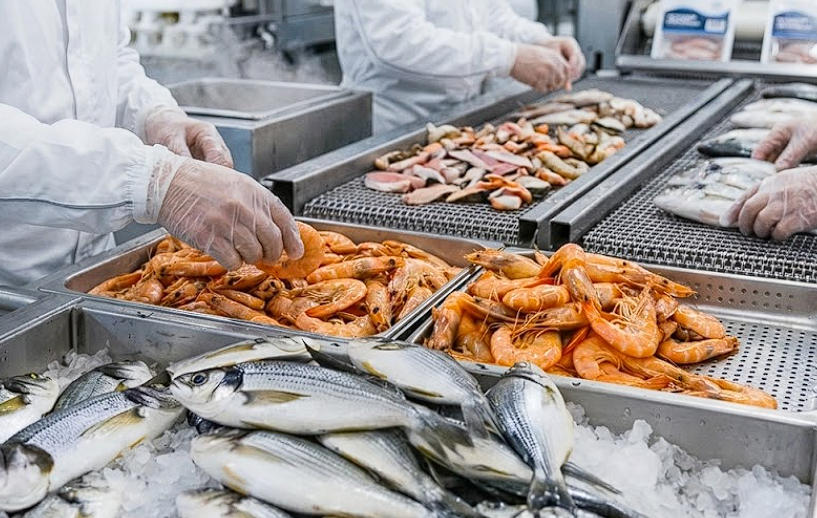
TKPP for Frozen Seafood Processing
How a potassium-based food phosphate can be evaluated for buffering, sequestration, moisture management and texture consistency in frozen seafood processing.
Editorial and source review · August 23, 2026
Quick answer
Why is TKPP used in frozen seafood?
Tetrapotassium pyrophosphate (TKPP, INS 450(v)) is a potassium-based alkaline phosphate. In permitted seafood formulations, it can contribute buffering, sequestration and protein-related functionality that processors evaluate for moisture behavior, thaw stability and texture. It is not a universal recipe: species, raw-material condition, treatment method, freezing cycle and destination-market limits all affect the result.
01 · Case context
The seafood processing question
A processor may need more consistent thaw behavior and texture across variable seafood lots while controlling surface appearance and sensory quality. TKPP is one option to evaluate when potassium-based phosphate functionality is useful and the intended treatment is permitted.
Scope note: Treatment permissions, maximum phosphate levels and labeling differ by seafood category and country. Confirm both production- and destination-market rules.
02 · Functional role
What TKPP can contribute
Seafood treatment should begin with a defined quality problem. These four functions can be assessed separately rather than assuming one ingredient will solve every source of yield or texture variation.
Alkaline buffering
TKPP can influence solution pH and process conditions; the full formulation must stay within legal and sensory acceptance limits.
Sequestration
Binding certain metal ions may help manage interactions that affect formulation stability and appearance.
Moisture management
Phosphate-related protein effects may support uptake and retained moisture when treatment conditions are well controlled.
Potassium option
TKPP enables potassium-based phosphate functionality, but any low-sodium claim must be based on the complete finished product.
Variables that change the outcome
- Species, size, season, freshness and prior freezing history
- Water quality, solution concentration, temperature and contact time
- Immersion, injection, tumbling or other treatment method
- Freezing rate, glazing, storage duration and thaw procedure
03 · Evaluation plan
Build a controlled seafood trial
Define the quality target
Select measurable outcomes such as uptake, drainage, thaw loss, cook loss, texture and sensory acceptance.
Prepare matched samples
Use comparable raw-material lots and a no-phosphate control. Record water quality, temperature, time and treatment ratio.
Follow the cold chain
Apply the intended freezing, storage and thaw cycle so the trial represents commercial handling.
Verify quality and compliance
Compare physical, sensory and analytical results, including total or retained phosphate where required, before scale-up.
| Stage | Measure | Decision supported |
|---|---|---|
| Treatment solution | Dissolution, pH, temperature and stability | Confirms repeatable preparation |
| After treatment | Uptake, drainage and surface condition | Shows immediate process behavior |
| After frozen storage | Thaw loss, appearance and texture | Tests cold-chain performance |
| After cooking | Cook loss and sensory quality | Connects processing with consumer quality |
04 · Quality and sourcing
Procurement checks for food grade TKPP
05 · Evidence limits and related decisions
Confirm the category before inferring performance
TKPP is tetrapotassium diphosphate, INS 450(v), but an additive identity or inventory entry is not universal permission for frozen seafood. Direct public evidence is also not equally strong for every species and process. Use the chemistry to design a trial—not to claim a guaranteed result—and confirm the exact national category, maximum level, calculation basis and label rule.
Seafood trial rule: standardize species, size, treatment temperature, contact, drain time, freezing and thawing. Measure thaw loss, cook loss, texture, appearance, sensory quality and retained phosphate—not immediate uptake alone.
06 · Frequently asked questions
TKPP in frozen seafood
What does TKPP do in frozen seafood processing?
In permitted formulations, TKPP can provide alkaline buffering, sequestration and functional phosphate effects that support moisture and texture management.
Why choose TKPP instead of a sodium phosphate?
TKPP supplies potassium rather than sodium. It may suit a potassium-based formulation strategy, but does not automatically make the finished food low sodium.
Is TKPP permitted in all seafood products?
No. Rules vary by seafood category and market. Confirm permitted phosphate types, limits, analytical requirements and labeling before use.
What should a seafood processor measure in a TKPP trial?
Useful measures include solution stability, uptake, drainage, thaw loss, cook loss, texture, appearance, sensory quality and retained phosphate where required.
What information is needed for a TKPP quotation?
Provide the standard, quantity, packaging, pallets, destination port, seafood application, required documents and delivery target.
Technical & commercial review
Discuss TKPP for your seafood process.
Include the species, treatment method, destination market, required specification, quantity, packaging and document requirements.